


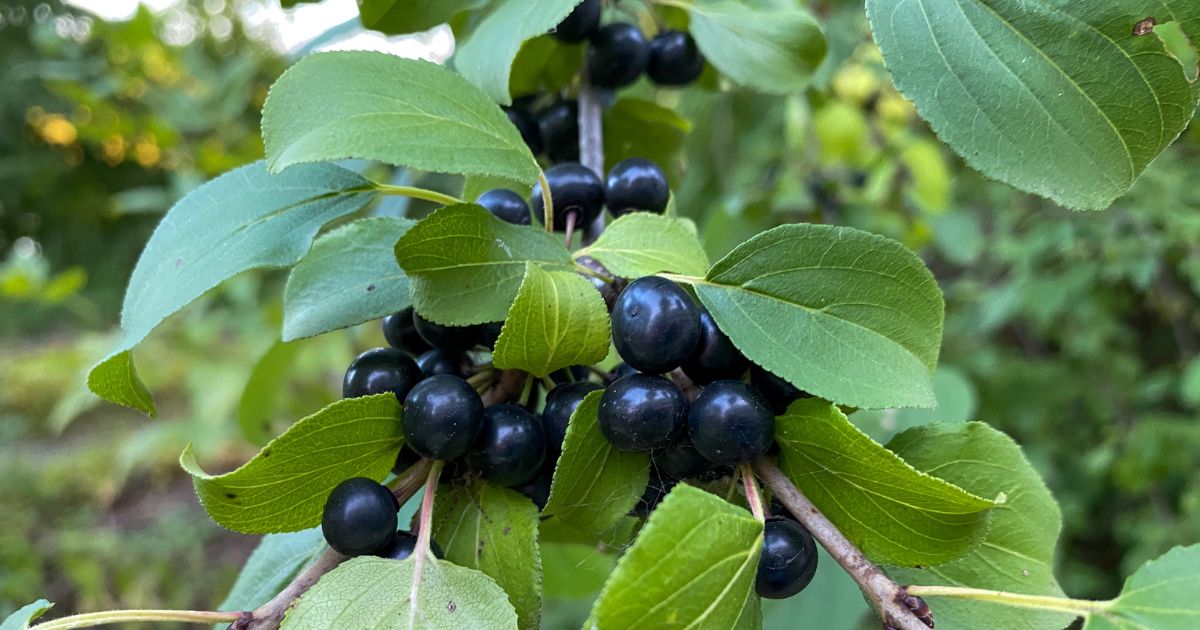
Natural Buckthorn Control
The solid steel vise at the business end of a weed wrench grabs ahold of the base of a 2” caliper buckthorn tree. As you lean slowly back on the wrench’s lever bar, tight roots snap away under your weight, jerking you and the buckthorn closer to the ground with each pull. The few remaining roots left intact are chopped through with your trusty Pulaski axe, releasing the tree from its earthen grip.
Surveying the damage, you note soil disturbance all around, crushed small native plants underfoot, and of course a few deep poke wounds on your arms and legs where the buckthorn lived up to its name, having jabbed you with 1” long bacteria-covered thorns.
After many years of wrestling with thorny competitors, you finally turn to the unthinkable: chemical warfare. Armed with the latest herbicidal concoction, you strike out through the
woods, bottle in hand, spreading synthetic death manufactured in a factory far away. The factory and its cancer-riddled neighbors, the oil used to create the herbicide, the fungi, insects, and water that will be destroyed while you seek revenge on this blight of buckthorn are merely collateral damage.
You are too busy winning over the buckthorn now to take measure of the outsourced consequences of your approach. After a few short weeks, the woods are barren, the understory gone, and who knows what chemicals are churning in your own body.
We’ve been told we must destroy them. We’ve been empowered to hate, trained to kill, and now all we can see when we look at the buckthorns on our property is our own neglect and ineptitude on display. The stand of buckthorn taking over our corner of woods is a forest-sized reminder that our approach has failed to sprout health, our dominion is constantly challenged, and our control over the environment is waning.
What if there was another strategy to manage buckthorn that grew ecosystem health along the way?
A Natural Approach to Buckthorn Control
A migrating bright yellow Tennessee warbler bounces along a dogwood branch growing out of a wetland inside 31 acres of habitat called the T. S. Roberts Bird Sanctuary. Located between Lake Harriet and Bde Maka Ska in Minneapolis, this Minneapolis Park Board-owned space is the story of a remarkable transformation.
Once covered in buckthorn and other invasive species, this land was taken under the loving care of a group of neighborhood activists called the Friends of Roberts Bird Sanctuary (FoRBS). Dedicated to an organic approach to landscape restoration, FoRBS has taken on the task of bringing health back to the land without the use of herbicides to control invasive species. Their approach to buckthorn is truly innovative.
Using what they call the High Cut Method, volunteers with FoRBS walk through the property cutting any buckthorn over 1” in trunk diameter with a hand saw. Instead of cutting the trees at their base, they cut them off at chest height. At that time, they also strip off any foliage or
branches that remain below chest height. Volunteers will then visit the plants two times per year for two years, spring and summer to remove any suckers or foliage that regrow. This method, which has been championed by the Friends of the Mississippi River, is now one of the most popular methods of natural buckthorn removal.
Cutting these plants at chest height has three advantages:
- First, it makes the tree you are revisiting highly visible and easy to spot in the woods, this is important so you can find the tree for subsequent revisits.
- Second, cutting at chest height weakens the tree considerably, especially when combined with removing leaves a couple times per year. Trees work hard to support their trunks and they use the sugars that they grow in their leaves during photosynthesis as food for expanding roots and canopy. When we remove a plants ability to photosynthesize by defoliating it and we leave a large trunk for it to try to support, the plant naturally begins downsizing its root system.
- This is where the third reason to practice high cutting comes in. After a couple years of shedding roots, the tree is fairly easy to pull out of the ground. Using the trunk as a lever, the volunteers at Roberts Bird Sanctuary revisit the trees they wish to remove and simply topple them over, uprooting the small root system that remains.
Replacing Buckthorn in the Native Woodlands
Once the buckthorn is uprooted, this is the best time to replant with native species. While the soil is disturbed, plant and seed to reclaim the space for native wildlife. Buckthorn are an understory tree that provide berries for birds. Replacing them with plants their equal in size and rival in ecosystem services is the long-term method of keeping buckthorn from retaking the woods.
Good replacements for buckthorn include dogwood, viburnum, snowberry, serviceberry, mountain ash, redbud, mulberry, sumac, leatherwood, and hazelnut. Always install new understory trees with ground cover perennials such as spreading native grasses, ferns, sedges, and native woodland flowers. Pennsylvania sedge, fescue grass, columbine, woodland phlox, wood sedge, and Solomon’s seal are a few native favorites sure to please the pollinators and help keep baby buckthorns from taking over again.
Using this level-headed approach to invasive species management, the volunteers at Roberts Bird Sanctuary have found a balanced and health building approach to buckthorn control. Instead of going wild wrestling and poisoning the buckthorn to death, they are letting plants die slowly, leaving large segments of root in the ground to feed beneficial fungi, and installing the next generation of native plants that will host and support the wildlife relying on this land for support. Their approach is regenerative and it shows. Roberts Bird Sanctuary is a verdant organic paradise representative of how portions of this land likely looked long before there was a city here.
There is a more peaceful path to health in the Upper Midwest landscape, but we’re going to have to reexamine our belief structure around buckthorn if we’re aiming at creating balance. Buckthorn and many non-native plants have forever become a part of our local taxonomy. Instead of aiming to eradicate, we can do our part to help regrow ecosystem balance by strengthening soils, controlling non-native species with level-headed approaches, and most importantly, replanting the wilderness that belongs here.
Russ Henry is is the owner and president of Minnehaha Falls Landscaping. He and his wife Chesney are leading valuable work in environmentally sound gardening and landscaping practices on the Twin Cities.


An interesting article, and strategies worth implementing. I am a resident and property-owner in rural South-Central MN, and have dealt with buckthorns for decades in my farmstead groves. I don’t use chemical control, and never will.
I applaud your stance to not use chemicals. In addition to keeping yourself and the creatures on your land safer, you’re preventing another bottle of poison from being sold and manufactured.
Hi Russ: Happy to read your article. I wonder if your approach will also work on other invasive species: Amur Maple and Honeysuckle.
Hi Catherine,
Thank you for the question. I do believe the high cut method will work on any tree or shrub. Wishing you luck in your restoration efforts.
EDIT: Since this original response, there is more recent information and research being done between the Friends of the Mississippi River and the University of Minnesota about the High Cut Method and how it mainly only works on buckthorn. You may find that here: https://fmr.org/updates/conservation/how-and-when-use-critical-period-cutting-method-remove-invasive-buckthorn
Do you have a photo of this “weed wrench”
I’ve been told few animals will eat the berries, & it has very little nutritious value for them.
They do eat them. Birds will eat them if nothing else is available. However, they are a laxative and are very bad for them. They are designed that way to spread the seeds. Rabbits eat them and you’ll see blue patches of snow. Nasty things that probably have some value in their native habitat. Not in North America though.
Unfortunately, when native plant food sources are scarce birds will eat the berries and drop the seeds, which accounts for so much spread of this invasive species in our natural areas. Mice and red squirrels as well as birds eat and disperse the seeds. But Buckthorn berries, mostly carbohydrates and low in protein, are not nutritious. They can have a severe laxative effect on some birds.
I did this by accident once in a patch. I wanted them to be high enough so I was not tripping over them, so I cut them off about 4′. This was before I knew they don’t just die like a normal tree vs. some demon tree from a horror movie. Anyway, some of them eventually died. I did prune them a few times. I’ll be doing this again this year for sure.
Dave, I love that you came across the high cut method on accident. I wish I had known many years ago, I could have saved a lot of labor.
I spent five hours over the last two days in my yard doing this. I still have more to go, and I have quite a brush pile to get rid of! I have five backyard neighbors, so I need to go around and ask them if they will consider following this, or perhaps allow me to do it for them. Our lot is the most wooded. I do also like using a weed wrench!
It’s very important to note they are male and female trees. Get rid of the female berry producers as fast as possible, and you can deal with the males at your leisure. Another thing I learned recently as I go into battle on my land to rewild with all native species.
I’ve used the same technique for prickly ash when it gets large. Never full control, but this prevents the clustering of suckers at the base of low cut plants.
Great article. Thanks for sending it.
What do you do with plants that have a 4”-6” base?
Hi Chuck,
The high cut method described in the piece will work for larger buckthorn trees as well.
If a community organization can afford it, goats (and sheep!) will also control buckthorn, naturally. We had some as pets, and they absolutely love buckthorn. The goats will stand on hind legs to browse the lower branches as well. Our pastures have no buckthorn whatsoever.
Liz, I’ve seen some amazing results from the use of goats as grazers to control buckthorn and other non natives. Goats are used in many areas also to PLANT! When penned in together at night with a straw of native grass with seed laid down as a mulch, the goats will move around overnight and their hard pointed hooves are perfect for squishing the seed down into the ground while of course leaving loads of organic “fertilizer” on the space overnight. Goats can be used in this way to restore prairie or woodland after they eat down all the plants. I’d love to see more use of goats in both buckthorn control and native landscape restoration.
Interesting method with potential for large areas, many trees, limited labor! Less labor intensive than covering short cut stump with can or black plastic; which kills year 1 (haven’t tried newspaper).
It’s a myth that Buckthorn berries are bad for birds. Research in Michigan has shown that birds gain weight after feasting on Buckthorn berries. That’s still not a good reason to keep it around and I’ve had success simply girdling larger Buckthorns and returning to remove the sprouts.
I liken Buckthorn berries to French fries. They taste good, but offer no nutritional value. Adding weight to those who consume them is consistent with that analogy.
Jack, Thank you for injecting some reason into the discussion on buckthorn berries. Agreed that buckthorn berries aren’t likely bad for birds and that we should do everything within reason to control buckthorn.
Also, it should be no surprise that buckthorn berries are a diuretic. Most fruit and especially berries are diuretic with birds. This is an evolutionary feature that allows berry seeds to pass through the digestive tracts of birds without being digested.
Can you please cite your Michigan source on this?
Thanks.
It is amazing what can be accomplished when we use time as an ally!
Interesting! I will try this. In the past I’ve been using the tree wrench on the smaller ones (<1.5"), and cutting the bigger ones to the ground and covering with black plastic. This has been working. though it means more effort, including picking up the plastic after a couple growing seasons. I also have garlic mustard and honeysuckle to deal with.
Very interesting we’ve always dug out before and it was a pain in the back I’ll try this method this year thanks for the info
We’ve found consistently mowing small buckthorn trees works well but native plants are slow to restart and at times get mowed down too. I’d like to try this method in my 3 acres of buckthorn infestation, however do not have the resources to plant new native bushes in their footprints. What about seeds gathered in the fall from prairie plants?
Jacque, I love using the native bee lawn seed mix along with dogwood or native willow cuttings as a low cost way to cover ground. Cutting red twig, gray, or pagoda dogwood or pussy willow stems and rooting them in water or planting them directly into moist spring soil is one way to cut costs on planting after removing buckthorn. Both dogwood and willow are keystone species that will serve hundreds of moth and butterfly species.
Although I truly admire the biological pioneers that created this new technique – and I will try it – I fear that for landowners with buckthorn infestations over 30 acres it will still require more worker hours than most will be able to provide. Spraying doesn’t work well either, and of course, it’s barbaric.
I can’t help thinking that a tool that would easily ring a tree would do the trick and not require a return visit thereby saving worker time. A standing dead ringed tree is probably better habitat for wildlife than a chest high stump. A battery operated small chain saw might do the trick for ringing but it’s still a bit dangerous. Something else that I intend to try is just walking through buckthorned areas with a battery powered hand drill and a 1/4″ super sharp carbide bit to drill one, two or three quick holes through stumps (1″to 3″ in diameter) at whatever height is most convenient to mimic the drying effect of ringing. Each thrust would make two drying holes. A very safe, quick and easy method…if it works.
But in the end, getting the word, and some training, out to neighbors (prevention) might be the best use of our time in the battle against exotics.
Hi Gary, I too thought that sever girdling would do the trick and sometimes it does. Buckthorn have shown me a fairly intense resistance to girdling at times and so, the high cut method. If a full 30 acres was filled with buckthorn, one person would likely spend a lifetime restoring it regardless of their methodology. We’ve all got a lot of work to do to restore the land to productivity and health, your innovative spirit is inspirational.
A friend of mine removed 15 acres of buckthorn and honeysuckle in the late 70s. He cut all of them down at ground level and burned them. Then mowed the area for two years. This stuff is the devil’s spawn. How can it be OK in its native country? I can’t wrap my head around that.
What do you do with the cut tops? Let them lay in the field or collect? Collect and chip? I’m head of a 145 acre conservancy in SE Wisconsin and cutting, collecting and getting rid of the plants once cut is very labor intensive and hard to get volunteers to help with that chore. In heavy stands that would leave a lot of slash covering attempts to re-wild the areas. I personally like this idea and will use it on my own property and will let the slash lay and record how the process works.
Paul, on large areas I try to get as much of the slash in contact with soil as possible by cutting branches from trunks and laying everything out. This allows soil fungi to colonize on the dead branches turning them into a mulch / nurse log for the remaining or newly planted natives. I’d love to get an update about how the process works for you over time.
Note: this article recommends some bad guys to replace the buckthorn.
It recommends mulberries. Our native Red Mulberry is extremely rare in Minnesota now because the invasive White Mulberry hybridizes with it and kills it out with genetic pollution. White Mulberry is also very invasive in Iowa (I know, I grew up in Des Moines, Iowa) and has taken over forests like buckthorn has taken over forests in Minnesota. It is starting to take over areas in the Twin Cities due to climate change. Do not plant White Mulberry.
This article recommends viburnum. Make sure you plant the native species. Sadly, most nurseries sell the invasive European Highbush Cranberry, yet label them as the native species. Since there are no regulations on this invasive species, they don’t have to be accurate in what they claim to be selling to you. American Highbush Cranberry (Viburnum opulus var. americanum) is edible for humans and wildlife. European Highbush Cranberry (V. opulus var. opulus) is inedible for people (tastes like dirty socks) and wildlife avoids the berries until they are starving. Research has also found that Asian Highbush Cranberry has been sold and planted, though no nursery claims to be selling it.
This article also recommends Mountain-ash. I have found dense infestations of European Mountain-ash around Duluth that is taking over the forest similarly to buckthorn. Again, make sure you are planting the native species, either Showy Mountain-ash or American Mountain-ash.
Good intentions with the wrong efforts will just cause similar or worse issues. If you are trying to do something right, you have to do it the right way. Just because a non-native plant species isn’t regulated in Minnesota, does not mean it doesn’t cause ecological damage over time.
Always plant native species. The non-native plants do not serve the ecosystems and the wildlife that call it home.
Hi Jeffrey, All of the shrubs I recommended are native to MN. While there are non-native varieties of most native plants, I always recommend the native varieties.
Has anyone tried this method with glossy buckthorn? Thank you!
I think it works even better on Glossy. They seem to be slightly less resilient.
I was so excited to read this article. Having ruptured 2 lumbar discs after an afternoon of buckthorn removal…I am NOT a fan! This technique sounds so much better in terms of body mechanics, it will require some time and patience however!
Thank you! This is a method I can do without poisons or physical injury! I am already spotting plants along my fences.
This method definitely works but it is very labor intensive. Just wanted to point that out for folks.
Do your research and do what is best for your site, if this is the best option for a site, awesome! But sometimes chemical is indeed the best option for a site. I still have GREAT success in growing native plants around the buckthorn that I have cut and stump treated. From observation I have seen less resprouting buckthorn with this method because there is less ground disturbance.
On sites where I have not used chemical and done either this method or a some combo of pulling, I have noticed more baby buckthorn from the seed bank being disturbed (even if I lay down native seed for competition). Though, it can be done this way! Just know that it is very much more labor intensive.
Hi Josh,
We found that this method is about equal in labor intensity to the cut and paint method. Even with the most effective herbicides, some cut stumps still sucker thus causing a need for a second and usually a third year visit to cut and paint sites for defoliating just as you would with the high cut method.
I must disagree on the labor intensity being the same. The cut and strip merged requires a minimum of 5 visits with stripping of leaves. The cut and paint may be done in one or possibly two. I have not fought buck thorns but have been waging war on autumn olive, ailanthus. Lonicera. Multiflora and bittersweet.
Our church is working to clear a large amount of buckthorn in our woods. We have tried replanting after buckthorn removal but deer destroy everything we plant. We have limited funds for this project. Any suggestions out there?
Hi Helen,
I deal with deer on my property and several client’s properties. The only way to keep deer out is with fencing. Encircle the new plants with deer proof fencing to keep the grazers at bay.
Common and glossy buckthorn are native to NW Europe including Scandinavia and the UK. I’ve seen it multitude of times in Sweden and England out in the wild, but it’s a one here, another there type of situation.
I’ve never seen a spot there yet where it’s taken over. I suspect all the other plants have adapted to its and all others chemicals over the millennia so it can’t dominate. Fire isn’t part of these ecosystems either. Here in the US: fire suppressed, no bugs that eat or feed on it, other plants not adapted to its chemicals = invasive.
Use Buckthorn Baggies (https://www.buckthornbaggie.com/). I had a huge issue with buckthorn, so I tried these after doing research online. I was skeptical it would work, but figured to give it a try from everything I read. No chemicals, you don’t disturb the root system or soil if on a hillside (which was a issue for me) and you can reuse the bags if you would like. They get pretty nasty after I collected them the following year. I’m not promoting Buckthorn Baggies website or anything, I was just happy they worked and I was surprised how many people haven’t tried this method. Give it a try and let me know how well it worked.
What do you do with buckthorn that is less than 1 inch in diameter?
Also, you say to use a hand saw. Why is that better than a chain saw?
I have a large sized weed wrench for sale if anyone is interested (up to 4″ in diameter)