



Ask a Master Gardener: What is a Walipini?
Question: I’ve read about low-tech greenhouses that are dug into the ground and require little to no electricity for heating. Do those work in the Upper Midwest?
Answer:
Greenhouses with foundations that are dug below ground level are often called walipinis, and they are a very cool concept. The word walipini comes from a language spoken in the Andes mountains of Peru and Bolivia in South America, where these types of earth-sheltered cold frames were devised to grow food year-round at high altitudes and in harsh weather. Google “walipini” and you will likely see this image:
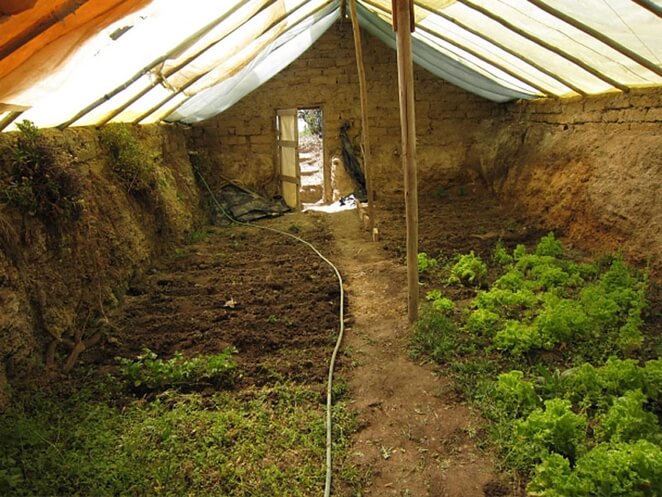
The idea is this: think of a traditional greenhouse, but instead of flooring that is level to or raised up from the surface of the ground, the foundation is dug down several feet. It’s a little bit like a root cellar, but with plastic sheeting or some other clear glazing for a roof. Insulation is provided by the bank of soil surrounding the greenhouse; often walls are lined with rocks or large water tanks to absorb as much solar heat as possible during the day and gently warm the plants next to them all night. It’s the ultimate eco-greenhouse, requiring no electricity to heat, even in winter.
Does a walipini work?
I asked Northeast Minneapolis resident Greg Strong, who is featured along with his backyard walipini in this Star Tribune article from 2016. Greg said, “It was a fantastic human-scale experiment that was lots of fun for community and for science.” Unfortunately, his walipini ran up against city codes in 2019 and had to be removed.
Nevertheless, Greg recommends trying it, especially if it can be done at no- or low-cost.
What should potential walipini enthusiasts watch out for?
Greg says there were several things he didn’t take into account that are worth noting. First, the water table rose so high during rainy weather that they sometimes had to bail water from the floor of his walipini. He was also really glad that they built it with free, found materials rather than shelling out hundreds of dollars—this made it less painful when they ended up having to remove it.
Walipinis require maintenance every year, so Greg also recommends starting small if you are interested in trying one and thinking of it more as a fun experiment to extend the growing season in your home garden, rather than a large-scale production opportunity. “A small walipini to get plant starts going in February and keep brassicas producing into December is a great tool and teaches lessons you can use on far larger scales outside the walipini,” said Greg.
Other considerations, if you want to build a walipini in the North:
The original design for these greenhouses was much closer to the equator than we are here in the northern U.S., so siting your walipini in a south facing slope, or building up a berm of soil on the north side of it, is going to be essential if you want our winter sun to be able to get at the plants inside. A too-deep walipini will result in little to no sunlight reaching the bottom during the colder months.
For this reason, earth-sheltered greenhouses might be a better compromise between the original walipini design and a classic greenhouse, here in the north. Earth-sheltered greenhouses are dug into the south side of a hill, so that the north wall is earthen, and only the south- and side-facing walls are glass.
Another thing to think about: if you don’t do any framing in the side walls of your walipini, they will eventually start to erode or even gradually cave in, depending on your soil type and the weather.
I found plenty of information on both walipinis and earth-sheltered greenhouses online. It’s always important to try and find information from northern gardeners when researching, especially with something like this where sun angle is critically important. Here are two:
Ceres Greenhouse Solutions in Boulder, Colorado, advises a modified walipini design that looks like this:

BC Greenhouses in Vancouver, British Columbia, Canada also offers good information about underground greenhouses. Their walipini design would cost far more than a DIY project, but may be more appropriate for northern latitudes while still taking advantage of the thermal regulation that burying a foundation provides.

As for larger-scale greenhouse growing, University of Minnesota Extension also has information on deep winter greenhouses, which are similar to walipinis but not dug into the ground. These are designed for small-scale market farms, but the principles would also work on the small scale.
Because this is a complex topic, here’s a checklist of considerations if you’re going to think about making your own walipini:
- City codes. Does your city or town allow a greenhouse with a sunken foundation?
- Water table. Do you live in an area with a high water table? How will you ensure your walipini doesn’t flood?
- South-facing slope. Do you have a hill or can you build up a berm to build your walipini into the south side of?
- Materials. What will you use to shore up the walls of your greenhouse, and what will you use for glazing? How will you get into and out of your walipini?
- Thermal mass. Will you add bricks, or large water tanks, or something else to absorb the sun’s energy during the day?
- Goals. Will you be using your walipini to overwinter fruit trees, or get starts going early in the spring, or grow greens year-round? Think about how you want to use it while you are still in the design phase.
Would you build a walipini or earth-sheltered greenhouse? Have you? Comment below on what you’ve learned.
More resources from U of MN Extension:
Basics on growing fruit for northern gardeners
Other gardening questions? Ask a Master Gardener via our online form, or call the yard and garden line at (612) 301-7590.
Other helpful resources:
The Master Gardener Volunteer program
Featured image credit: Aerin Aichi, CC BY 2.0 https://creativecommons.org/licenses/by/2.0, via Wikimedia Commons
Jennifer Rensenbrink is a University of Minnesota Extension Master Gardener Volunteer for Hennepin County. She somehow has two mini-prairies on her tiny south Minneapolis property.
You may be interested in:
Build a Cold Frame
Gardening in the north is rewarding but challenging—summer days are long and warm, but there aren’t always enough of them to accommodate all our gardening…
What is a Cold Frame?
While northern gardeners often use various protection methods to give seedlings a jump start in spring, adding a more permanent solution to your garden can…
Get Your Vegetable Garden Growing with a Cold Frame
One way to extend the vegetable growing season—both on the front end in spring and on the back end in fall—is to use cold frames,…