



Carnivorous Plants are Friendlier than I Thought!
I recently had a blast writing about carnivorous plants for Northern Gardener magazine. I’ve always been fascinated by them. I mean, most of us plant geeks tend to humanize our green babies anyway… talking to them, giving them names, endlessly worrying over their well-being. Why wouldn’t we love them?
But a plant that eats things? That always felt a little intense for my foliage collection, which never speaks and always seems happy to see me. I’ve admired Venus flytraps and pitcher plants from afar but never wanted one in my house. I didn’t want to witness little bugs gasping their last breath in my sunroom.
But then I met the sundew.
Getting to Know the Carnivorous Sundew
Delicate, glistening, weirdly glamorous… cape sundew (Drosera capensis) caught my eye with its fine, dewy tentacles and compact, rosette form. For the past three months, I’ve watched him—Sunny, I call him—slowly but surely unfurl his leaves. The little hairs and sticky surface sparkle in the sun.
I read that if a carnivorous plant looks generally good and is producing new growth, it’s somehow getting insects. They only need one or two a month, and since it’s fruit fly season, it must be happening.
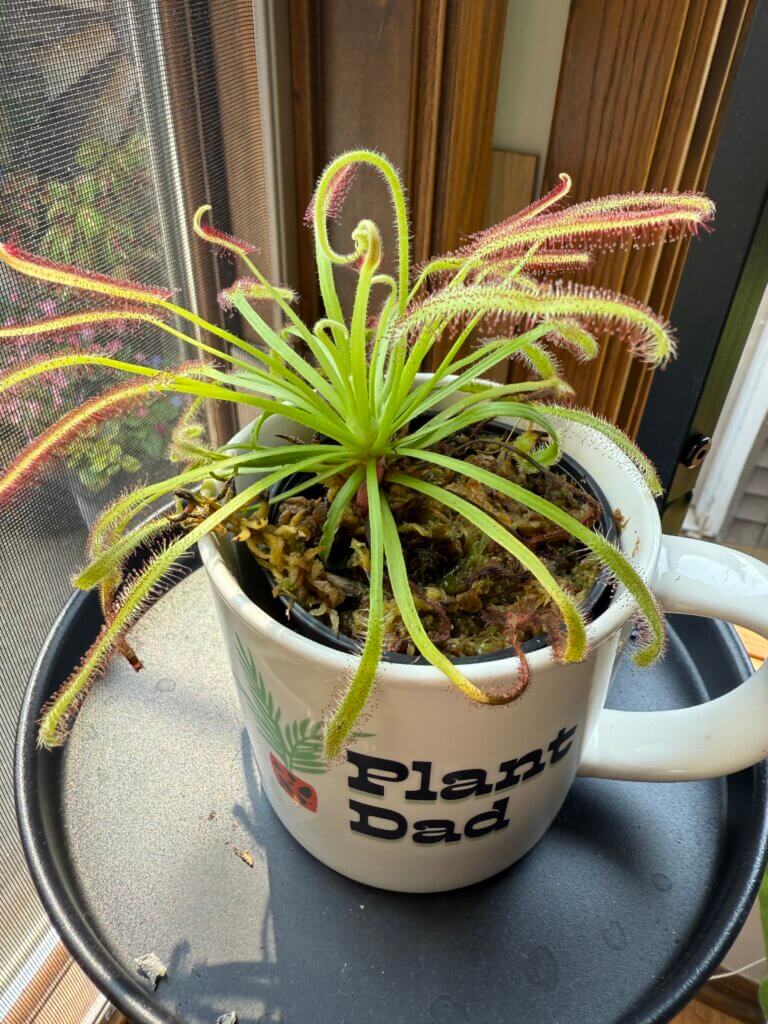
My sundew moved in next to the orchids and African violets, perched on a sunny windowsill in a tiny basket of moss, nestled in a coffee mug I keep half full of distilled water. I watch it uncurl new sticky leaves like ribbon candy. It’s become oddly endearing.
And then today, I finally saw it: a tiny fly struggling on a sticky leaf. And, yep, I rescued it. Old habits die hard.
A Few Sundew Basics, If You’re Tempted
- They love humidity. Think sunny bathroom or a humid windowsill with a tray or cup of water like I do.
- Distilled or rain water only. Tap water can harm them—this part is non-negotiable.
- Full sun or bright light. Mine thrives in a south-facing window with unfiltered, unabashed sunlight.
- Don’t feed it! It’ll catch what it needs. Really. If it looks happy, it’s getting what it wants.
- Resist the urge to touch. Those sparkly tentacles are sensitive and meant for hunting, not poking.
I never thought I’d be cheering on a carnivorous plant, but here we are. The garden drama continues—and sometimes it has a little bite.
FYI: I purchased my sundew from Joel’s Carnivorous Plants via Amazon. I recommend it as a source. The plants came to me very healthy and with everything I needed to get started. Plus, Joel punctually answered my parade of questions. Seems like he loves all his babies, too.

Eric Johnson is a longtime contributor to Northern Gardener, blogger and lifelong gardener in Roseville, Minn.
Photo credit: Eric Johnson.


Hello! I’ve grown carnivorous plants for 5-ish years now and I love them! They certainly help keep the insects down during the season. However, I’ve found that I can use tap water as long as it’s filtered by a really good water filter, such as a carbon block model. I check my TDS (total dissolved solids) and as long as it’s below 20, the water won’t hurt my plants. My municipal water is 145 TDS. The solid carbon block filter reduces that to 9. That’s worked well for me. If trying something like a Brita pitcher I would check the TDS reading before using.