


Tips for Watching Butterflies Find Host Plants for Their Caterpillars
Your garden can be a place to watch the incredible drama of an insect’s life unfold. But it’s helpful to know what to look for. One behavior I find particularly fascinating to watch is butterfly host-searching.
Host plants are the subsets of plants that a caterpillar can feed on. Butterflies are often adapted to a narrow range of plants as hosts because they need ways to overcome the plant’s defenses, whether toxic chemicals or damaging hairs. A female butterfly may have 500-1000 eggs to spread across host plants in the week or two that she lives as an adult. How does she find all of those specific plants? You can watch the process in your own backyard!
Watching Cabbage Whites in a kale field
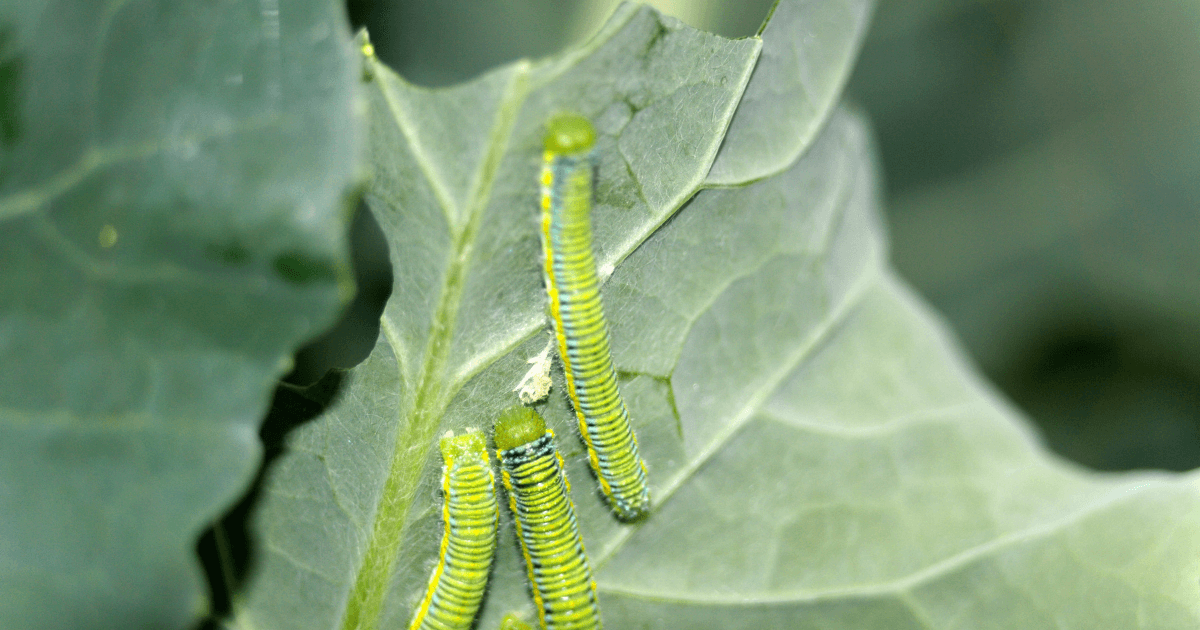
Let’s consider the cabbage white butterfly as an example. Plants in the mustard family (cabbages, radishes, watercress) are hosts of this butterfly. Females can tell from smells in the air that the hosts are nearby and go into “host searching mode.” This is a slow, fluttering flight usually close to the ground, where females are landing on plants as they are fluttering.
But they are not stopping to sip nectar—instead, they “drum” their little front legs on the plant leaves and taste the plant with chemoreceptors in their legs. If the plant contains chemicals associated with their host plant, they stop briefly to lay an egg.
For cabbage white butterflies, those indicative chemicals are “glucosinolates”—a group of chemicals that make mustard taste spicy to us. You can see this process in action in this video of a cabbage white female in a field of kale. She flies along, fluttering close to the plants, landing frequently. She stops a few times to curl her abdomen under the leaf to lay an egg. Egg-laying is fast, often taking one a second or two before the female moves on.
A female in a kale field is presented with an abundance of hosts. But what about a female butterfly in a more natural environment, where a mustard plant might be buried in a field of dozens of other plant species, which are not host plants?
Females can land on each plant and taste them to see if they are hosts. But this is a remarkably inefficient process, especially if you have 500 eggs to lay in a week! Fortunately, butterflies can learn cues associated with host plants that are common in the local environment. Color is a big cue that butterflies pay attention to—indeed, butterflies can see a broader range of colors than we can (although their resolution is not as good as ours).
They can also use shape and plant size to find host plants. The cool thing is that we can actually watch this process in action because females sample possible host plants by landing on them.
Cabbage Whites Learning in a Laboratory Setting
At the start of this next video, we see a female butterfly who is for the first time experiencing a host plant (We know this because it’s an individual I raised as part of my dissertation research, hence the label on the butterfly!).
The female goes into host searching mode, initially landing not just on hosts in the array of plants (green cabbage), but also non-hosts (a green and a red-leaved geranium). When she lands on those, she tastes them with her feet and moves on. When she lands on a cabbage, she stops briefly to lay an egg. The video below has a few clips spread over a 20 minute period—by the end of it, the female is primarily landing on the green cabbage.
If you want to learn more about the study this video came from, check out this publication: https://www.journals.uchicago.edu/doi/abs/10.1086/597609 Note: this paper may be behind a paywall—if you would like a copy and can not access it, please email Emilie for a copy!
Wasps in a Kale Field
Flying along those same plants, you might notice paper wasps, like the ones in these videos. Paper wasps are frequent predators of cabbage white caterpillars.
In the first clip in the video below, you can see a wasp moving up and down the rows of kale. They are visual predators and will stop to attack and kill caterpillars. They will process their prey into caterpillar “meatballs”, which you can see in the second clip.
They deliver these nutritious packets back to their nest for their own larvae. Paper wasps are an interesting part of the insect garden drama. They are also important if you do not want caterpillars to completely defoliate your plants!
Monarchs Ovipositing in the Field
You don’t have to be in a lab or greenhouse setting with marked butterflies to see their learning in progress. You can watch it in your own yard if you have an idea of which plants are host plants of the species you are watching. Monarch butterflies lay their eggs on milkweeds, and have a similar low, fluttering flight when they are looking for milkweeds. As they land on plants, you can use their “mistakes” to get an idea of what they are searching for.
This last video is from my yard, and I apologize that it’s a pretty nausea-inducing video as I spin around to try to follow the butterfly (in my defense, it’s pretty hard to follow a spastic butterfly with a camera).
At the start of the video, the female monarch lands on a few milkweeds and then pauses briefly to lay an egg on one of the plants. Then she takes off to look for more hosts, and lands on a honey berry bush, sampling it briefly as a possible host (but she moves on).
Why did she land on that plant but not the tree or the asparagus or the garlic or strawberries in that same garden? It’s impossible to know for sure, but I would hypothesize that it’s because of all of those plants, the honey berry bush was the most similar to the milkweed in terms of the plant height, the leaf shape and color—all plant traits the butterfly was using in her search.
These host-searching butterflies are just the tip of the iceberg for insect behavior you can watch in your gardens—the micro scale of your own “Homegrown National Park.” What are other types of insects or insect behavior that you wonder about in your garden? Post some questions below for ideas for future blog posts! Or send them to Emilie (emilies@umn.edu)

Emilie Snell-Rood is a biologist at the University of Minnesota and has been gardening for decades to feed her family and butterflies.
You may be interested in:
Plant Profile: Compass Plant
Seeing a prairie or a meadow full of blooming compass plant (Silphium laciniatum) in mid-to-late summer is an optimistic sight. Among the three species of…
Native Plants That Compete Well With Non-Native Invasives
Is there an area in your garden or property where it’s hard to get rid of non-native invasive plants? Or maybe you have a section…
Grasses and Butterflies: A New E-Book Explains Connections
While many gardeners plant coneflowers, milkweed, black-eyed Susans and other blooming plants to help butterflies, ornamental grasses are also vital to the eco-system of these…