


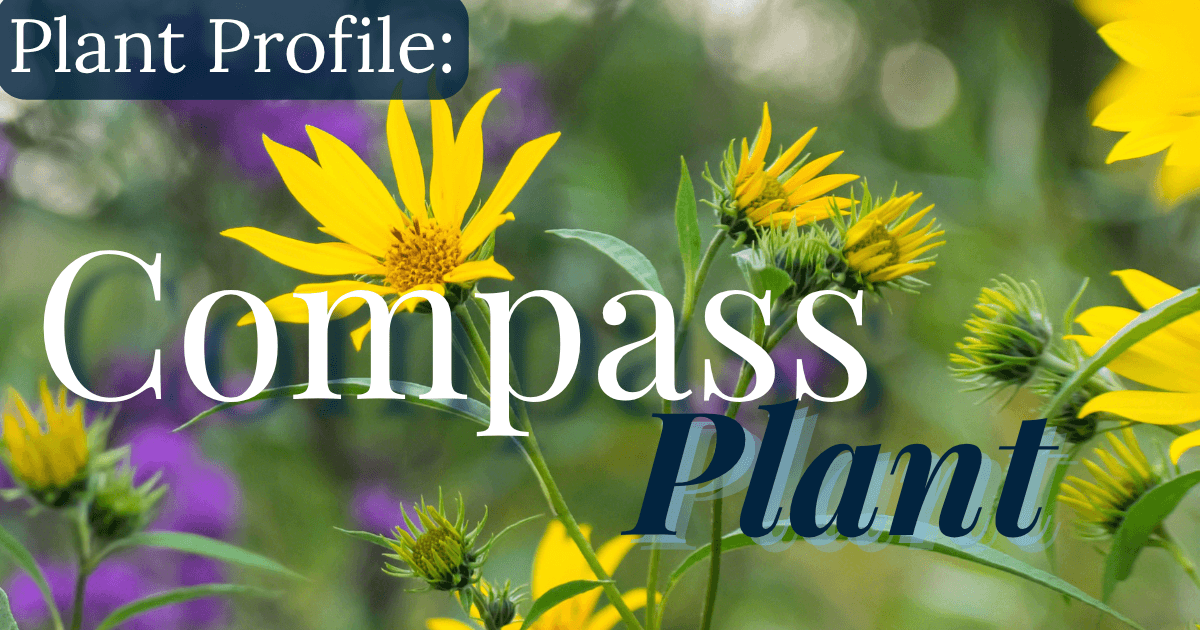
Plant Profile: Compass Plant
Seeing a prairie or a meadow full of blooming compass plant (Silphium laciniatum) in mid-to-late summer is an optimistic sight. Among the three species of Silphium native to Minnesota, compass plant (S. laciniatum) is easy to distinguish by its deeply divided, lobed foliage. The flower stalks are also among the tallest, reaching up to 12 feet.
Getting Oriented with Compass Plant
The name ‘compass plant’ comes from the orientation of the large (1- to 2-feet long) basal leaves in a north-south direction (their flat surfaces face east and west) to avoid the direct rays of the midday sun. The leaves also stand vertically, limiting their exposure to direct solar radiation. Another common name, gum plant, derives from the fact that the hardened sap of the plant can be chewed like gum.
Like many blooming plants in the aster family (Asteraceae), compass plant has special value to native bees, as noted by the Xerces Society for Invertebrate Conservation. Long-tongued bees — including bumblebees, miner bees, large leaf-cutting bees and others — are the primary pollinators of the flowers.
Other visitors include flies, wasps, butterflies and hummingbirds, as well as other birds and wildlife, some of which eat its seeds in the fall. Compass plant is a host plant for the rare Silphium borer moth.
Garden and Ornamental Uses
While often prevalent naturally in prairie settings, compass plant, even as a single plant in a garden, can provide a dramatic, bright focal point. It offers an attractive anchor and protector
for other plants below it. Resembling a sunflower, compass plant is a long-lived, reliable plant with a deep tap root. It adapts well to native plant gardens and the backs of large borders. It’s easy care, drought tolerant and low maintenance.
Great companion plants include native plants in its natural habitat, such as butterfly milkweed (Asclepias tuberosa), purple prairie clover (Dalea purpurea) and rattlesnake master (Eryngium yuccifolium). Other good garden companions include drought-tolerant stonecrops (Sedum spp.) and complementary-colored plants such as globe thistle (Echinops ritro) and blue
sage (Salvia azurea).
Navigating Compass Plant Care
This tall prairie plant prefers full sun; dry to average, well-draining sandy or loamy soil and room to grow. In a garden, because of its deep taproot and preference for drier conditions, it’s a good choice for an open area, with shorter, shallower-rooted plants at its base. It’s also best in a flatter, non-sloped area of the garden or near a structure for support, as it can become top-heavy.
Compass plant may take2 to 3 years to reach its full stature, partially because its early growth is directed toward its deep taproot. Once established, however, individual plants can live to 100 years. Established plants readily self-seed.
To propagate, start with seeds or seedlings. Seeds can either be planted directly in the garden in fall or cold-stratified for planting in spring. Bright yellow compass plant blooms waving in the wind in late summer and early autumn provide a dramatic show. An added benefit: They offer an excellent perching spot and nectar source for bees and butterflies.
Compass Plant: At-a-Glance
This article originally appeared in the Sept/Oct 2022 issue of Northern Gardener Magazine.

Beth Stetenfeld is a Wisconsin-based garden blogger and writer, native plant enthusiast and a master naturalist volunteer and instructor.
plantpostings.com | @plantposter
You may be interested in:
Plant Profile: Snake Plant
Snake plant (Dracaena trifasciata or sometimes Sansevieria trifasciata), is one of the easiest houseplants to grow, which explains its popularity in malls. It’s a great…
Plant Profile: Jade Plant
One of the easiest houseplants to grow, jade plant (Crassula ovata) is native to provinces on the eastern side of South Africa and in Mozambique….
Plant Profile: Popcorn Plant
Smells are powerful, and the scent of popcorn plant (Senna didymobotrya) will bring you right back to the movie theaters of your childhood. This plant,…