


Colorful Sun-Loving Bloomers for Partial Shade
Do you have a partially shady garden, with patches of bright sun here and there? Do the sunny spots shift throughout the growing season and from year to year? Wondering if there are sun-loving plants that will perform well in partial shade/partial sun?
Most sources define partial shade as areas that receive about two to four hours of sun each day. And they define partial sun as spots that get four to six hours of sun. If your garden is like mine, it will also depend on the season, the angle of the sun, and the weather.
My garden is framed mainly by oak (Quercus spp.) and honey locust (Gleditsia triacanthos) trees, so as a deciduous woodland, its plants receive plentiful sun early in the growing season before the trees leaf out. And during the summer, the plants have dappled sun throughout the day. Over the years, I’ve discovered many sun-lovers that survive, and even thrive, in less than full sun. Here are a few examples:

Crocuses, winter aconites (Eranthis spp.) and other spring-flowering bulbs. These early bloomers crave sun, but they emerge and flower before the tree foliage is full. They bring bright patches of colorful blooms and welcome the first emerging pollinators in the springtime.
Bearded irises (Iris germanica). Here’s another plant that emerges early in the season. Although the flowers don’t bloom until late spring/early summer, they begin to form earlier in the growing season.
Wood betony (Pedicularis canadensis). I don’t have this plant in my garden, but I’ve observed it while hiking in both sunny and partially shaded locations. Note: wood betony is a hemiparasitic plant that can photosynthesize but often attaches to host plants, such as short grass species.
Blue-eyed grass (Sisyrinchium spp). I was surprised to learn that these sweet, little bloomers can tolerate dappled shade. Mine are growing under two crabapple trees (Malus spp.), and they receive some morning and a little late afternoon sun.
Wild bergamot (Monarda fistulosa). Another plant that I don’t have in my garden (I need to add it), wild bergamot or bee balm seems to thrive in dappled sun. I’ve seen it many times in deciduous woodlands just blooming away.
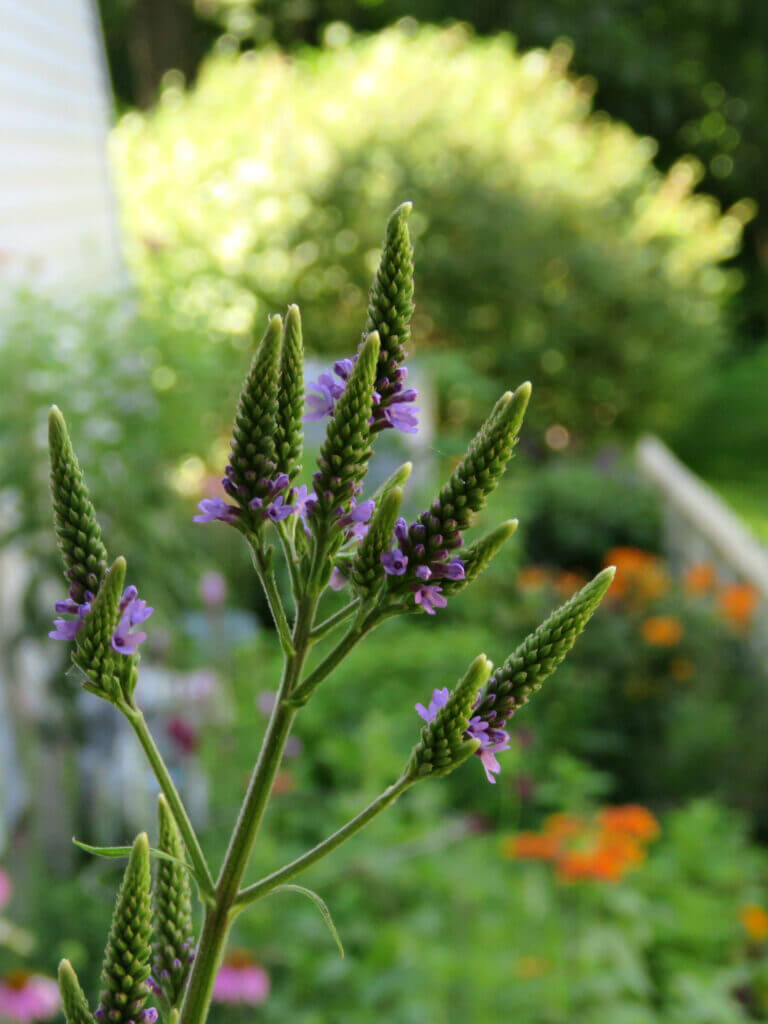
Blue vervain (Verbena hastata). My blue vervain is planted in a spot that gets hot, direct sun for only a few hours of the afternoon. The rest of the day, it’s shaded or partially shaded. It’s thriving and welcomes many pollinators during mid- to late summer.
Swamp milkweed (Asclepias incarnata). A milkweed that blooms in partial shade? Yes, there are several, including swamp milkweed. This plant has thrived for me in several locations—those that get dappled sun throughout the day, and areas that receive direct, bright sun for only a few hours. And it’s a preferred host plant for monarch butterflies.
These are just a few examples of flowering plants that adapt and thrive in partial shade/sun. You can find more suggestions from Nature Hills Nursery, Swansons Nursery, or your favorite seed/plant source. And, of course, there are many colorful plants that actually prefer partial shade to shade. If you have areas that get at least a few hours of sun exposure each day, it’s fun to experiment and add a few more bright, colorful bloomers to your garden.
Beth Stetenfeld is an organic gardener, native plant enthusiast and garden blogger and writer. She’s also a master naturalist volunteer and instructor.
You may be interested in:
Shade Tolerant Vegetables to Try
For vegetable gardeners on mature lots, deciding what to plant can be tricky. Most vegetables need a minimum of six to eight hours of…
Try These Perennials for Extreme Sun
Full sun is usually described as six to eight hours of sunlight per day. But some gardens may be sunny eight, 10 or even 12…
Color Trends 2021: Illuminating Yellow and Gray
Each year, the color-matching company Pantone lists a Color of the Year that expresses the mood of the time and tends to influence color trends…