


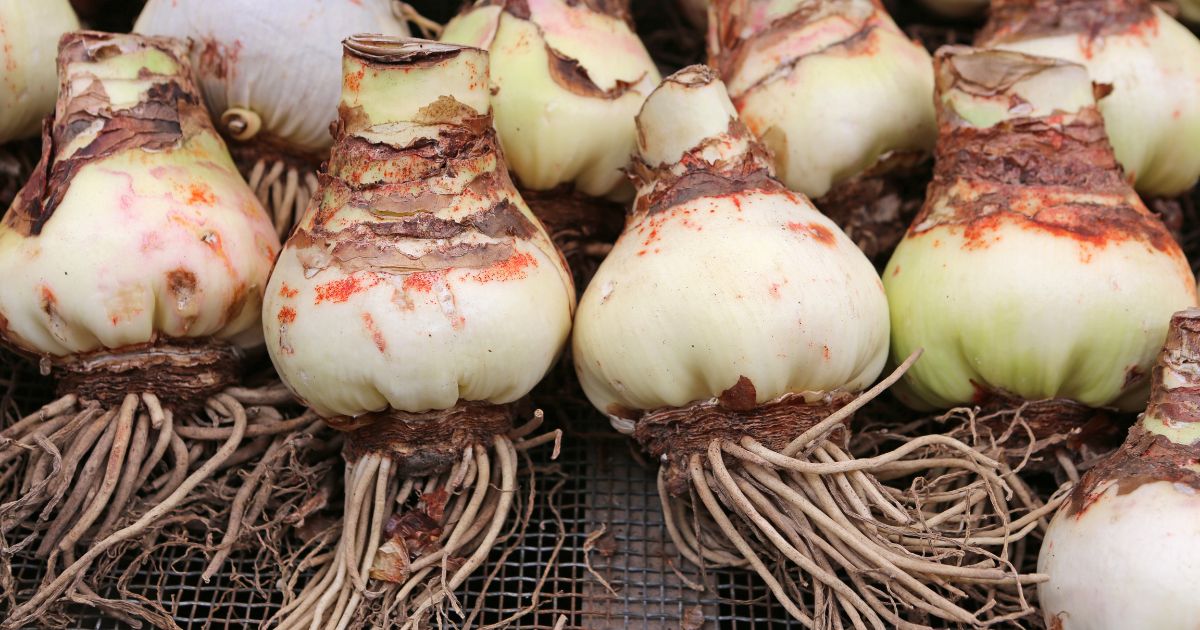
Ask a Master Gardener: How and When to Plant Amaryllis Bulbs?
I admit, I shudder a bit to see Target being transformed into a Christmas wonderland around Halloween, but at the same time, it was a good reminder: time to plant amaryllis bulbs! Let’s demystify what is actually a fairly easy process—it just requires some planning.
Q: When should I plant amaryllis bulbs to have blooms around the holidays?
A: Now!
Okay, that’s it, next question. Just kidding. You can usually force amaryllis bulbs to bloom in about 6-8 weeks, but in my experience that timeframe can vary quite a bit. Is your house a bit on the cool side, like mine? It may take longer than 8 weeks.
If you want blooms on December 25, plant amaryllis bulbs the first week of November. If you’re not too fussy about the actual timing of the bloom, then start them anytime during the month of November. It’s not like you’d be sad to have a giant red flower blooming in your house in January.
I’ve been growing amaryllis bulbs for many years, mostly because it’s simple. The hardest part is remembering to start them.
I planted mine this weekend, so I put together a photo tutorial for you.
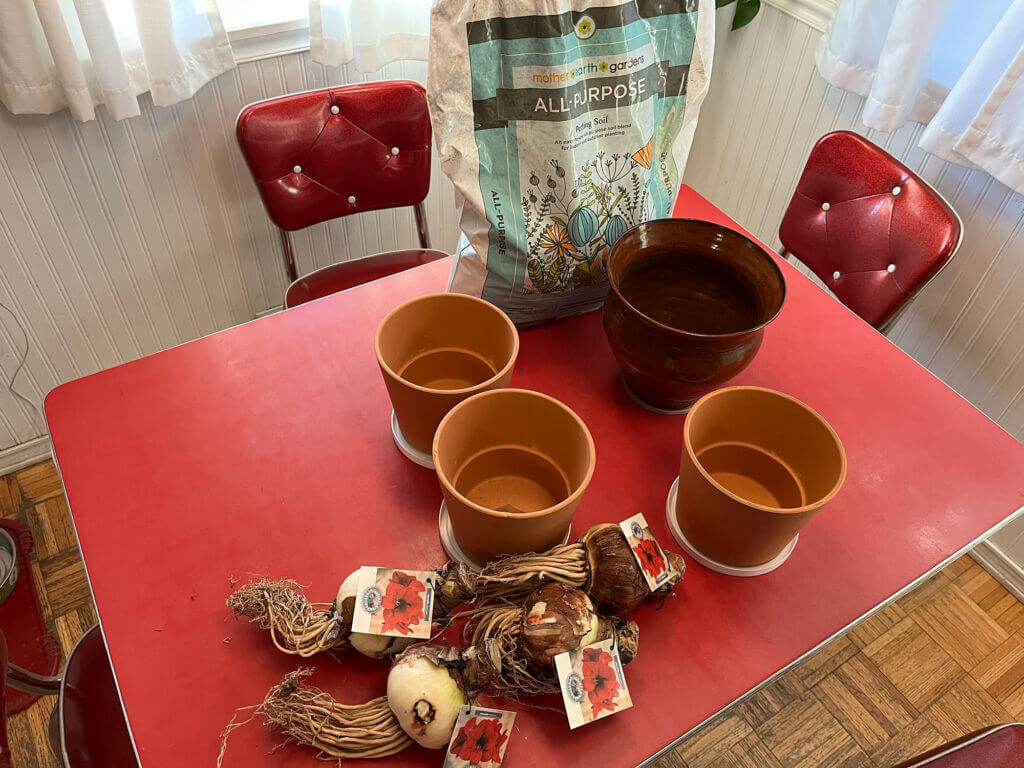
First, gather your stuff.
I am giving away 3 of the 4 bulbs I planted to family members, so I used 4 pots. To grow a single bulb, the pot should be just a little bigger than the bulb itself-these little brown ones are 6 inches high by 6 inches in diameter, just about perfect.
I’ve also grown 3 bulbs together in one larger pot. Pots can be a little bigger than this, but if you go smaller you could end up with a top-heavy flower.
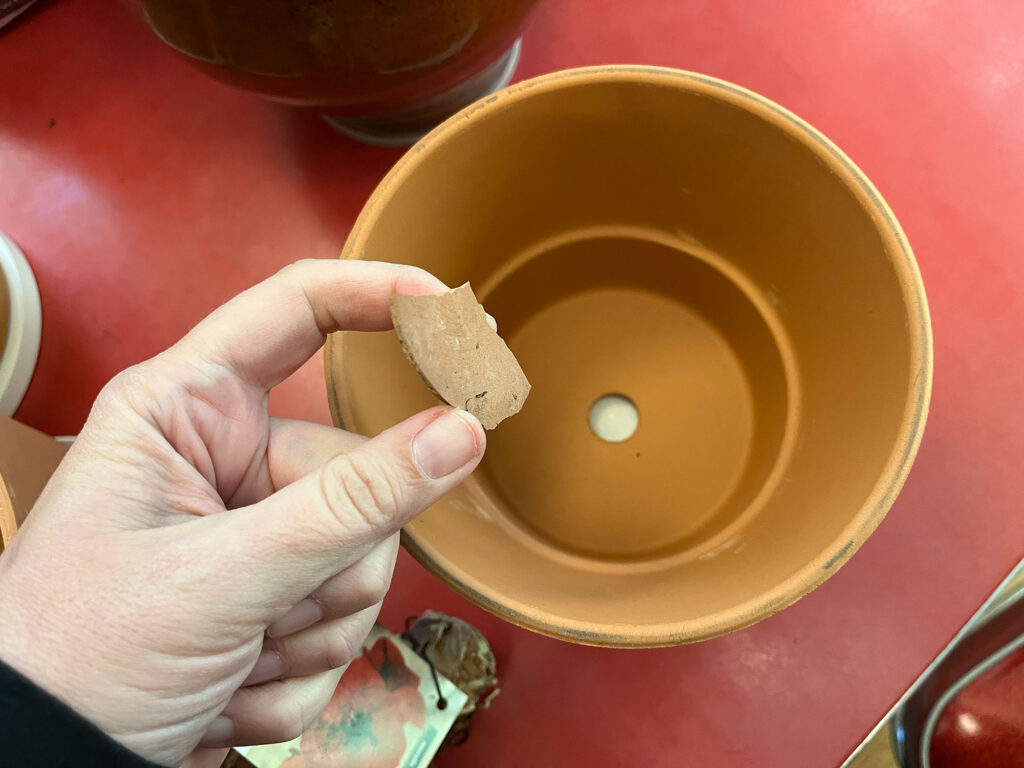
Pots should always, always, have drainage holes.
This is especially true for amaryllis bulbs. They don’t take up a ton of water so it can be easy to overwater them and then you risk rot. I have made this mistake before.
I like to put a shard of old broken pottery over the hole at the bottom just to keep things slightly neater.
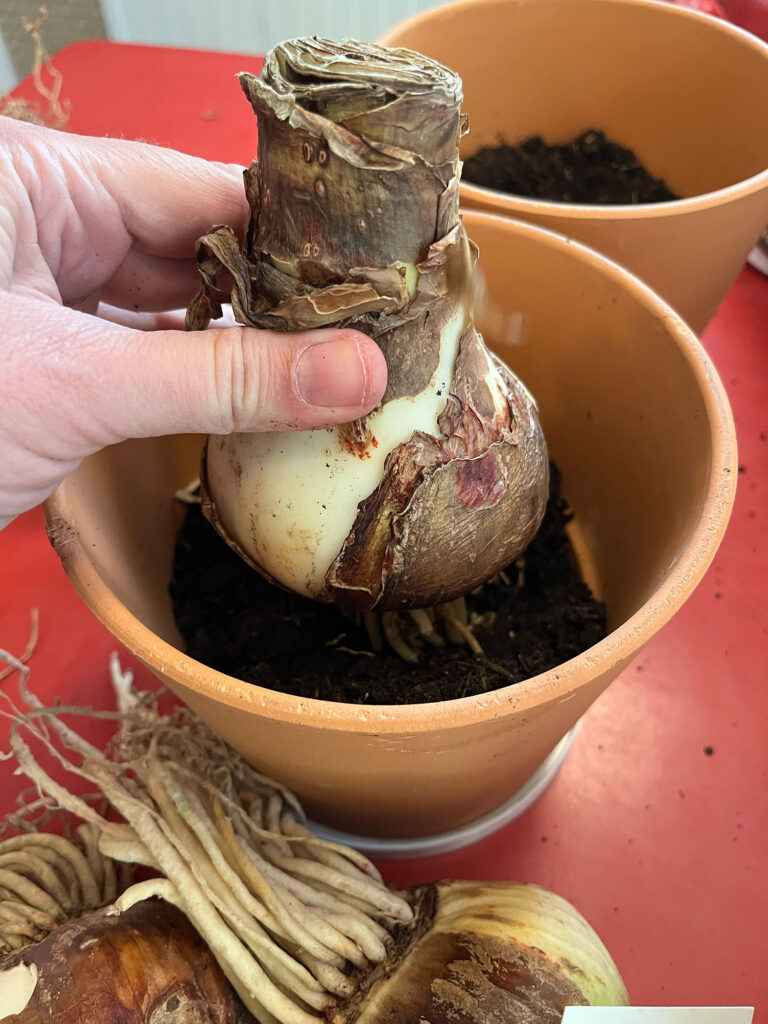
Next, fill the pot about one fourth to one third full of potting soil.
Make a nice well in the center of the soil.
Grasp your bulb so that the roots hang down into the well and the top sticks out a bit above the pot.
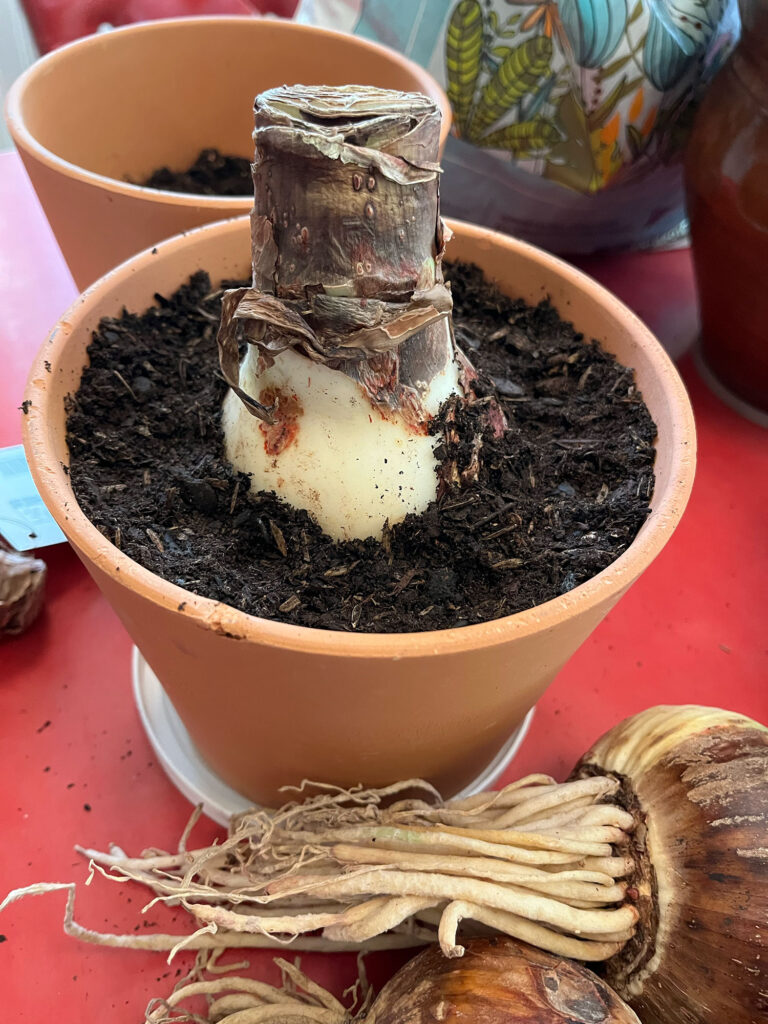
Using your other hand, fill in with potting soil and pat gently into place.
Approximately half the bulb can and should be sticking up above the surface of the soil.
Give it a good soaking of water, until the water starts to run out the bottom of the pot.
Dump excess water out of your catchment tray after it’s done.
If you wish, put a decorative mulch on your pot. I’ve used a variety of things for this, but this year I’m using some shredded wood packing material that was in a box of some plants I had shipped to me this summer.

Monitor over the next few weeks.
Figure out where you want to place it during the long waiting game. I always find bright, indirect light, whether that’s natural (a south-facing window) or artificial.
Water sparingly, always checking the surface of the soil to see if it’s dried out before adding more.
Within a few weeks, your bulb should send up a thick green stalk. As it gets bigger, the stalk may require staking, especially as the flower gets closer to blooming.
Amaryllis bulbs can be saved and reused from year to year, but it’s not simply a matter of keeping them alive. They will grow lots of foliage after blooming, and this is the time to fertilize them regularly.
Then, in the late summer, they need to be dried, put somewhere cool or cold for 8-10 weeks to trick them into thinking it’s winter. To be honest, I have tried a handful of times and never successfully saved an amaryllis bulb and gotten it to rebloom. If you want to try it, this is a good tutorial.
Good luck with your indoor bulb experiments this winter!
More resources from the Master Gardeners
Do you have some late fall gardening questions? Ask them in the comments below! We’ll check in and answer as many questions as we can for the rest of this week. If we don’t get to yours, you can Ask a Master Gardener via our online form, or call the Yard and Garden Line at (612) 301-7590.
Other helpful resources:
- Yard & Garden Home
- What’s wrong with my plant?
- What insect is this?
- The Master Gardener Volunteer Program
Jennifer Rensenbrink is a University of Minnesota Extension Master Gardener Volunteer for Hennepin County. She somehow has two mini-prairies on her tiny south Minneapolis property.
Great step-by-step tutorial! Remember, a bit of color in January is wonderful!
We have had success re-blooming Amaryllis for several years, just by putting them in a dark place (doesn’t have to be a blackout) that is cool. They stay in their pots during their hibernation. Our dark space becomes a little warmer in the Spring and isn’t quite as dark, so that’s when the new, green spike shows itself. We have Amaryllis in early summer that way, keeping them on the deck where they get bright light but not much full sun. I am guessing that if we put the bulb and pot inside a fabric black cloth where the cool spot is that might be darker enough to keep the plant dormant until November, but it’s fun to have them in the early summer.
I do much the same as above. I stop watering in August and cut back the dry foliage in early September. We also have a modestly dark place in our cool garage. I leave the plants in their original pot. Sometime in November I repot the plants and anticipate blooming in January. They will usually rebloom for several years.
Thanks for the tip! I’m inspired to try again this year with saving my amaryllis bulbs.
I purchased last year a bulb with a wax covering that did not need to be watered. It’s been in my living room the entire year now. I see a green sprout coming. What should I do?
Do I take it out and peel off the waxy shell and put it in a dark place?
Hi Carol! I have been really curious about those wax-covered amaryllis bulbs that I’ve seen in catalogs. I would try to peel the wax covering off, plant it in a pot, and put it in a cool dark place for a month. I have tried several times to get an amaryllis to re-bloom and haven’t had much luck. It’s still fun to try though! Here’s a helpful tutorial:
https://www.gardeners.com/how-to/get-amaryllis-to-bloom-again/5411.html
We have been growing Amaryllis for about 40 years. I let them bloom and then when they are done blooming, I do add fertilizer and keep watering them but sparingly and then in about June when no danger of frost, I plant them in the garden and just leave them alone until August when I bring them into garage and dry them out on newspapers and put them in the basement. I prefer to have them bloom in February when it is so dark and winter is wearing on me. So after I take down the Christmas decorations, I pot up the amaryllis bulbs and water them and have blooms in Feb. I have way too many bulbs. Before my husband passed away, he found a plant that had seeds and so he planted them and we read that it could make bulbs and blooms in about 4-6 years and this past year I had one bloom! Usually they just have baby bulbs and so I have many plants. It really brightens up February!
The Amaryllis we have were already
planted in the yard when we moved
to our home over 53 years ago. We never took them out of the ground and very rarely gave them water and yet we have had many blooms thru the years. Recently, we had some
yard work done, and all the Amaryllis bulbs were removed, and there were several hundred all shapes and sizes put in to two large plastic bins. Not having had to plant any before and these bulbs never being exposed after all these years
Except the new ones, how do we determine which ones are okay to
keep and re-plant and after being in such a harsh sunny location does that mean these bulbs can tolerate
being re-planted in these same kind bd of conditions with little or on a drip watering system?
Hi. First time grower here. Mine is just splitting to open. Hope I don’t sound thick when I ask this – when it’s finished do I cut the stalk off and when I put it in a cool dark place do i keep the bulb still in its soil and pot? I’d love to keep the bulb and try and get it to flower again when the time is right! Thank you!
I have bought 4 amaryllis bulbs from Holland this May and brought them over to Malta. I was said to put in the ground in October and so leave them in a dark place.
The thing is that they started to grow – and had flowers, now they are blooming again.
I don’t know what to do. If to leave the stems or cut it.
Thanks for your help
I’m located in Northern Florida and have a spot where Amarilis have been growing and blooming for several years. However, that bed is now filled with Torpedo grass that needs to be removed. The only way that I know to get rid of the pest is by removing all the soil and exposing the entire root system of the weed. However, this can’t be accomplished without disturbing the Amarilis. Our first frost usually occurs about mid-December. Considering this, should I delay the work until then and how careful must I be with the bulb roots? Any recommendations on how to best accomplish this undertaking would be greatly appreciated!
Yes, this is very likely not the way to deal with amaryllis, but…. I’ve just kept mine growing year-round, I think going on 2 years. So both of them have very long leaves on them. No blooms in December. What do you think I should do with them? They look VERY healthy, and they are huge!
Received an amaryllis in November as a gift. It was supposed to bloom by Christmas. It’s now May and has grown 7 – 2 foot long leaves, very healthy, but no sign of a flower. What could be the problem?