


Photosynthesis—How Your Garden Grows
Here’s an interesting question: where do your plants’ stems and leaves actually come from? In other words, where do plants get the raw materials that they need to grow? A tiny seedling begins with very little mass; a couple of months later it becomes a mature plant many times the original size. Where did it get the building blocks to create all that new material?
Out of thin air
A first impulse might be to guess that plants get their material “from the soil.” It’s easy to imagine plants reaching down into the dirt with their roots, “feeding” on the ground and somehow using that to grow. The idea kind of makes sense, but it’s not accurate. Think about it—if plants consumed soil to grow, you would constantly have to add soil to potted plants, which of course isn’t the case. And hydroponics are obviously successful without soil at all.
In order to build stems and leaves, plants need something else, something to form a rigid structure. Ideally, the building block for this would be a chemical element that easily combines with other elements. Thankfully, there is such an element—it’s carbon—and plants obtain it in a most ingenious way, straight from the air.
You might think of air as being mostly oxygen, but it’s actually a combination of gases: a lot of nitrogen, plenty of oxygen, some argon and a small but important dusting of carbon dioxide. It’s this carbon dioxide that is critical for plant growth, and life on earth in general.

So what happens? Plant leaves absorb carbon dioxide from the air, then shrewdly combine it with hydrogen gathered from water (water, of course, is collected through the roots). Through a complex transfer of electrons, the plant miraculously transforms carbon, oxygen, and hydrogen into glucose—a type of sugar that excels at storing energy. From there, plants can use the glucose to form cellulose, which they use to actually build their structures. So in the end, plants transform simple ingredients like water and air into leaves, stems, and fruit! The soil provides some essential nutrients, but nothing substantial.
But we’ve glossed over one major point—where did the plant get the energy to perform these wonderful chemistry tricks in the first place? Where does the energy stored in the glucose come from? That is where the sun comes into play—and the reason why leaves are green.
Sunlight = Energy
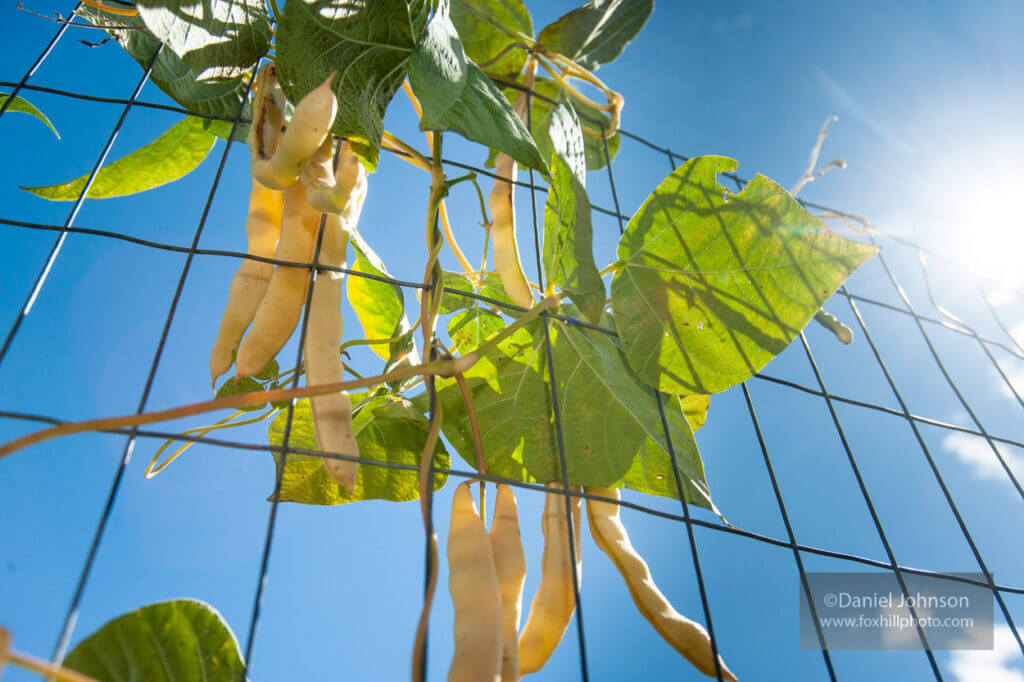
Sunlight is “made” of individual “pieces” of light called photons. The same holds true for indoor artificial lighting. Photons make up the light we see in the world, but they also pack a pretty powerful punch of energy; you can easily perceive this on a warm day just by feeling the warmth.

Plants do more than just enjoy the light and heat; plants put photons to work with their leaves. Cells inside the leaves contain chlorophyll, a light-absorbing pigment that collects red and blue light from the sun and reflects green—and the energy taken from the photons by the chlorophyll is used to power the electron-rearrangements needed to transform the carbon, hydrogen, and oxygen into glucose and eventually cellulose to make stems and leaves. Wow! Obviously, increased sunlight means more of these sun-powered chemical reactions can take place, but recent research shows that even a single photon is enough to start the photosynthesis process. (Interesting side question: do plants photosynthesize moonlight too? Or even starlight?)
Naturally, this is an extremely simplified description, and there are many complex components to this whole process that we don’t have space to dig into. But the main takeaway is that plants literally create their stems, leaves and fruit “out of thin air”—with the help of water, soil nutrients and energy (light) from the sun. Your garden is an amazing place, both beautiful and productive, and there is a lot of amazing science happening “behind the scenes” of your favorite plants.
Daniel Johnson is a Wisconsin-based freelance writer and professional photographer and the co-author of over a dozen books. See his garden and animal photography at foxhillphoto.com.
You may be interested in:
Gardening Curriculum Resources for School Gardens
Starting a school garden may feel a bit overwhelming. Where do you start? The resources below are helpful for answering general gardening questions. Planting the…
Your Tomato Questions Answered
It’s tomato season! Delicious tomatoes, sun-ripened and fresh from the vine—what’s better than that? Of course, any gardening endeavor produces questions, and you may be…
Canada Thistle
Invasive species removal is the most difficult challenge I encounter in my gardening work, and Canada thistle (Cirsium arvense) is my biggest adversary. Most northern…