



5 Tips for Late Frost Plant Protection
Picture this. It’s early June, you have a sprinkling of new seedlings in the ground and forecasters are predicting frost overnight. Don’t panic. It seems like every year at least one late-May or early-June frost sneaks in on a clear, high-pressure night. The problem is that this one cold night is probably bookended by weeks of warm, sunny, spring weather when you want to be out in the garden. Luckily, there are several fast and simple DIY methods for protecting your ternder seedlings from the cold.
For the sake of this article, we’ll consider a gentle spring frost where the overnight air temperature overnight might dip down to 36°F for perhaps a couple of hours, but where the objects near the ground (like your seedlings) might go below 32°F. Most of these tips won’t hold in something more severe.
Tip #1: Use sheeting to cover raised beds
This is really easy to do and doesn’t take long. Plastic sheeting is often sold in rolls 3’ or 4’ wide or more—perfect for stretching over the width of your raised wooden garden beds—and it’s easy to cut to the right length. You could also use some old bedsheets for this purpose.
Use a simple staple gun and you have all you need to create a custom-made piece of insulating cover in minutes. If using plastic, clear sheeting works well enough, though black gathers warmth more quickly once the sun rises. Be sure to remove the sheeting carefully as soon as the morning temperature is safe, as there will be a lot of condensation underneath. Fold up and save your sheeting after it’s dried for use again in the fall.
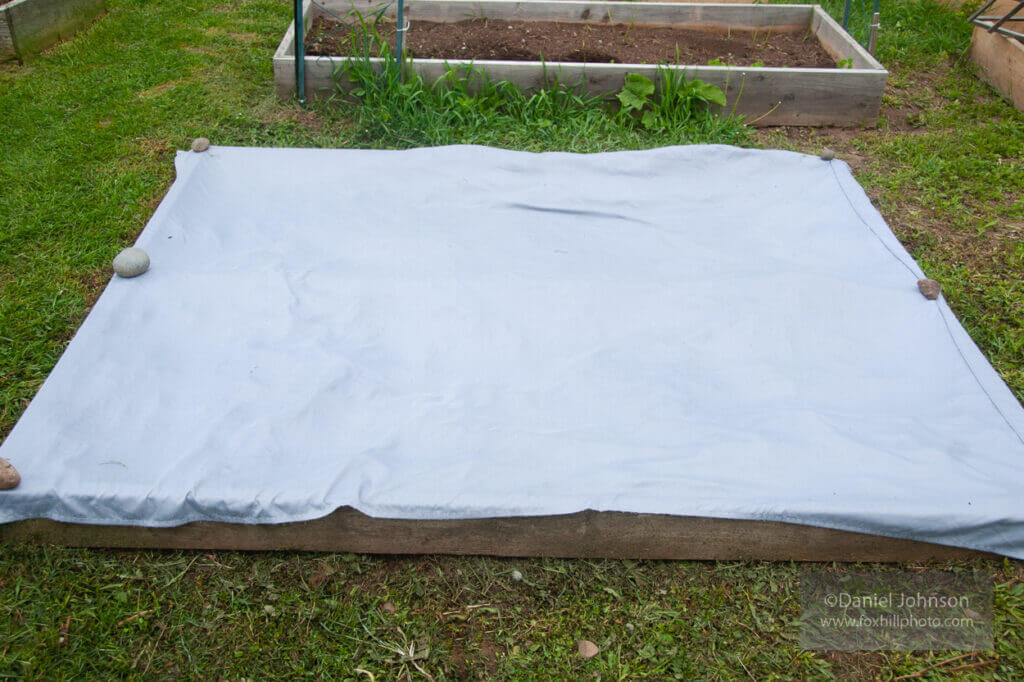

Similarly, you can cover in-ground beds with sheeting, protecting rows of seedlings. In this case, you might need to use short garden stakes to hold up the center of the sheet (like a circus tent) so that it doesn’t touch the seedlings directly, as the insulating air space is critical. You could also try fleece blankets, but nothing too heavy.
Tip #2: Protect tiny seedlings
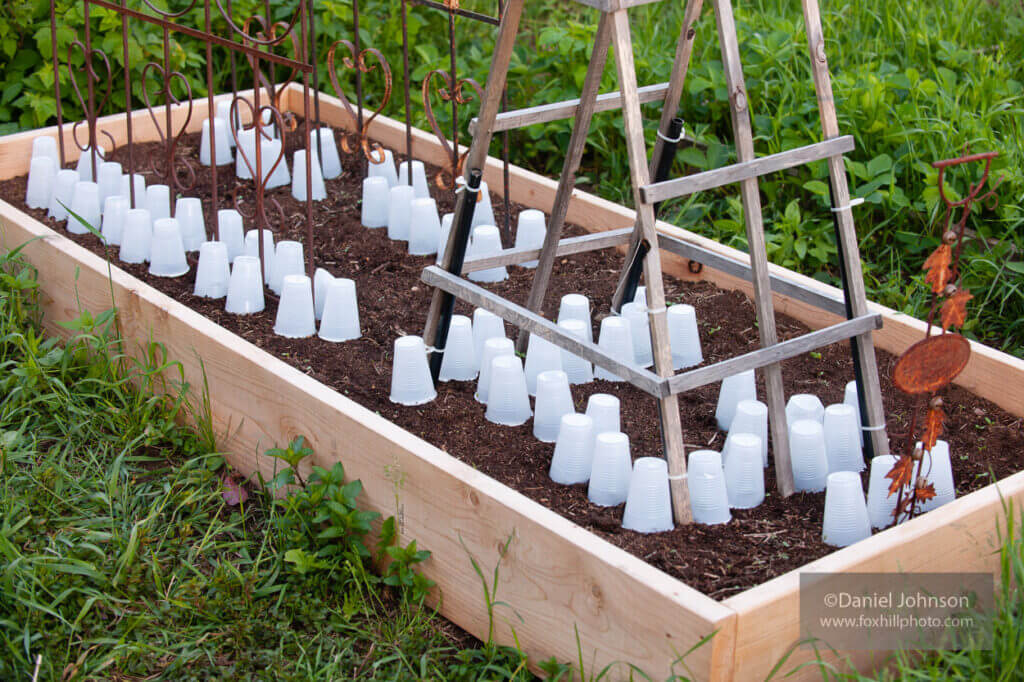
Small seedlings that are less than a few inches tall can be protected with any number of methods. The idea is to simply create air space between the delicate seedling and the harsh temperatures. Glass or plastic cloches are an obvious choice and work well, but you may not have enough of them. With the sun going down and the thermometer dropping, use whatever’s handy: buckets, empty pots, even small cardboard boxes. In a pinch, you can use drinking cups—keep a box of party-sized cups on hand in your shed or garage and you’ll have plenty to go around for individual seedlings year after year.
Tip #3: Protect blossoms
You have control over when you put seeds and seedlings in the ground, but you don’t really have control over when your fruit trees blossom—and they’ll probably start to set flowers at the first opportunity, placing them in real danger of frost damage.
Since your fruit harvest depends entirely on the success of the blossoms, it’s in your best interest to lend a hand when possible. It might be possible to cover young fruit trees with sheets, blankets, or similar items, but this can get unwieldly and impractical in a hurry. A better solution might be to actually water the soil around the base of your fruit trees prior to the freeze. The wet ground will stay warmer, and the very act of the water cooling will release heat, which will rise right to where you want it. Many orchards combat frost using this method, as do some berry growers.
Tip #4: Use cold frames to extend the season
Cold frames are basically mini greenhouses. In a pinch, you can move potted seedlings to them, although their real purpose is to give cold-sensitive plants a head start. This means you’ll need to plan ahead with your cold frames—it’s not as easy to add them after the fact. If you’re growing any plants in containers, you can move those to the safety of a garage or, if nothing else, crowd them alongside the outer wall of your home for added warmth.
Tip #5: Don’t worry unnecessarily
Finally, some early growers that can handle a little chill and won’t be adversely effected by the frost. Cold-hardy specialists like garlic, onions and chives will likely be fine, as well as things like lettuce, kale, spinach and root crops like carrots or radishes. Peas, too, and any seeds you’ve planted but haven’t yet germinated won’t need protection from the cold.
If you can safely guide your seedlings through one more cold night, you should be all set for a productive growing season. Good luck!

Daniel Johnson is a Wisconsin-based freelance writer, professional photographer and co-author of over a dozen books. See his garden and animal photography at foxhillphoto.com.
One Comment
-
Pingback: Frost Protection Tricks Every Gardener Should Use In Spring
Back to BlogYou may be interested in:
Fall Planting: How Late Can You Go?
Fall is a great time for planting. As we get past mid-October, though, the question is how late in the season can you plant? Many…
Snow and Plants: How Much Insulation?
After a winter that has featured an odd amount of rain, followed by very cold temperatures, we have finally gotten some snow. Several days of…
150 Tips: Growing Summer Bulbs
When is the best time to plant summer bulbs? While some horticulturists say you can plant them in September, most gardeners plant them in early…