



4 Common Insect Pests in the Vegetable Garden
Before we even start talking about pests, let’s be clear: Most bugs are good bugs, and trying to keep your vegetable garden bug-free is not only an exercise in futility, it’s not good for the food you are going to eat or the planet. One way to keep destructive pests at bay is to plant native plants that attract beneficial insects nearby.
Now, on to identifying four pests most likely to be seen in northern vegetable gardens.
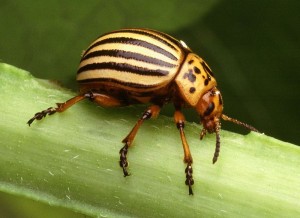
Colorado Potato Beetle
Colorado potato beetles spend the winter in gardens and potato fields, emerging in May, about the same time as potatoes. The adults mate and females can lay up to 350 eggs on the leaves of a potato plant. When larvae emerge, both adults and larvae eat the leaves, which can really decimate plants.
Once they get through the potatoes, they move to tomatoes, peppers and other members of the nightshade family. For home gardeners, the best control is to patrol your potato patch regularly, picking the adults and either squishing them or dropping them in a bucket of water and looking for the distinctive orange-yellow egg masses on the backsides of the leaves. When you see those masses, smoosh them. That should do a lot to reduce the population.
Cutworms
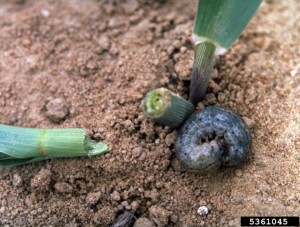
There are several species of cutworms that bother northern home gardeners. Most cutworm damage occurs in spring when the worms, which are larvae of moths, slice through the stalks of transplanted vegetables. A sure sign of cutworms is the neat cut at the base of the plant, with the seedling toppled over beside it.
If cutworms are a problem, try using cutworm collars made of cardboard rolls, such as toilet paper rolls. You place the rolls around the stems, a few inches below and above ground, effectively blocking the worms from getting at your plant. Here’s a video showing how to use cutup drainage pipe in a similar fashion.
Squash Vine Borers
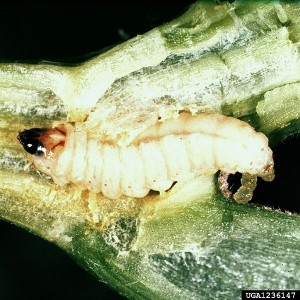
Squash vine borers are the larvae of another type of moth, the clearwing. They are a problem for a relatively short period of time each summer, but they can wreck havoc in the vegetable garden during those weeks.
The adults emerge from the ground in late June or early July and lay eggs at the base of susceptible plants, usually summer squash, winter squash and pumpkins. The eggs hatch and burrow into the stems and vines of the plant, basically eating their way through the vine, and killing the plant from the inside.
Once they are done feeding, they drop into the ground, make a cocoon and stay there until the next summer. They can be tough to control and your best strategy may be to plant vine crops that the borers don’t like, such as butternut squash, cucumbers and melon. You can also cover your plants with row covers when the clearwings are flying around, though you want to remove the covers after the plants have flowered to give bees access to the plant for pollination.
Finally, some gardeners wait until mid-July to plant out their squash. Depending on the variety, you likely will still get a crop and the borers are safely underground at that point.
Tomato Hornworm
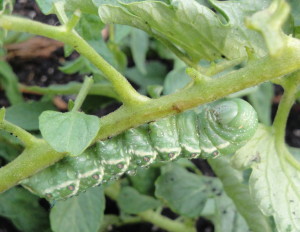
Tomato hornworms may not be super common in northern gardens, but I’m including them for two reasons:
- I have a very cool photo of one (below)
- When you have tomato hornworm, your tomato plants can be destroyed in days.
Hornworms get their name because of the stinger-like horn protruding from their back end and they are the caterpillar of sphinx moths. They feed only on members of the Solanaceae or nightshade family. Tomatoes, peppers, potatoes and eggplants are the most notable vegetable members of the nightshade family, which also includes petunias, tobacco, tomatillos and Datura, among others.
Hornworms are about the size of your pinky, but because of their coloration, they are very difficult to see on plants. If you see defoliation on the top of your tomato plants, head to the garden right away and look for hornworms. If you find one, cut it in half (Gross, but effective, and totally organic). There probably are not very many hornworms there—but get rid of them if you want tomatoes.
I’d like to close with three resources vegetable gardeners can turn to when bothered by pests. First, the University of Minnesota has a great website on garden insects and a very helpful diagnostic page, What Insect is This? You can also check out this book, Garden Insects of North America: The Ultimate Backyard Guide by Whitney Cranshaw (Princeton University Press, 2004)

Mary Lahr Schier is a Minnesota gardener, writer and editor and author of The Northern Gardener, From Apples to Zinnias, 150 Years of Garden Wisdom (Minnesota Historical Society Press, 2017), winner of the Silver Award of Merit from GardenComm in 2018. For 18 years, she edited Northern Gardener magazine, the publication of the Minnesota Horticultural Society and the only magazine dedicated to gardening in USDA Zones 3, 4 and 5.
You may be interested in:
Three Common Garden Pests
For the sake of the planet, we will not be sharing some of the tips and techniques recommended by MSHS in the distant past for…
July Garden Checklist for Northern Gardeners
Updated July 2025 With heat, humidity and occasional rains, many gardens will be exploding by early July. Fortunately, we gardeners can enjoy them with a…
Welcome Garden Season with the May/June Northern Gardener
The May/June 2019 issue of Northern Gardener should be on newsstands this week, and from its bright green cover to the special ads at the…