



Golden Squash Sourdough Bread Recipe
My sourdough starter (named Vincent van Dough) is a very hard worker. We’ve memorized our standard recipe to the point that I’ve definitely mixed the dough while half asleep. Once in a while, we’ll make some bagels, English muffins, or a sourdough potpie, but most often, I’m throwing together my basic two-loaf recipe on a Tuesday night because I’m about to run out of bread for my morning eggs and toast.

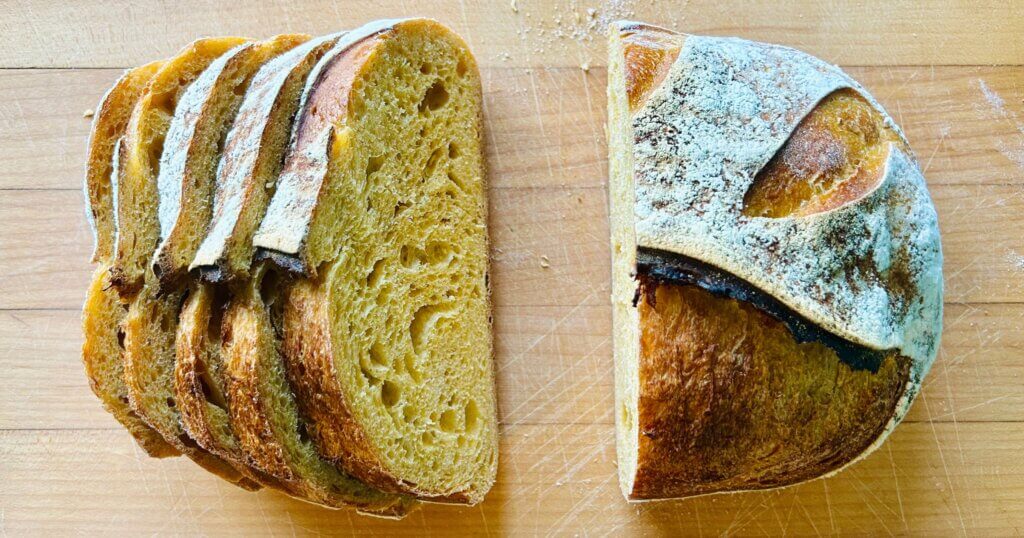
This fall, with an abundance of squash in storage, I decided to break out of my normal sourdough routine. I started replacing some of the water in my standard recipe with squash puree to make a slightly sweet, beautifully golden-tinted loaf of sourdough. The color of this bread is truly the show-stopper; whether you use canned pumpkin puree, or home-roasted and mashed kabocha or butternut, you’ll get a gorgeous marigold color. Throw in some chopped fresh herbs or a handful of pumpkin seeds to add a festive sprinkle of green.
This recipe makes two one-pound loaves in a batard or boule shape. I like to use one loaf right away and put the other in the freezer for later (or, if you’re very generous, gift it to a friend.)

Golden Squash Sourdough Bread
Makes two one-pound loaves
Ingredients
950g AP flour (I’ve found up to 300g can be a whole grain without sacrificing texture)
200g fed, active starter
20g salt
250g squash puree
400-450g water
Up to 2 Tbsp add-ins (chopped herbs like rosemary, thyme, or sage, or a small handful of seeds like pumpkin or sunflower.) Optional
Instructions
- Mix the dough. Combine all the ingredients and knead until there is no dry flour. If you started with 400g of water, wait to add more until you’re absolutely certain you need it. The amount of water you use will change depending on your type of flour and the weather outside. Once mixed, cover and allow the dough to rest for 20 minutes.
- Stretch and fold. Lift up one side of the dough, stretch it upward as far as it will go, then fold it over the top – repeat on the other three sides. Complete these stretch and folds 3 or 4 times, waiting 20-30 minutes between each round. Tip: wetting your hand before stretch and folds will help prevent the dough from sticking to you.
- First ferment. Allow the dough to rise undisturbed until doubled in size. In the warmer months, this could be 4 hours; in the depths of winter, it might be 12 hours.
- Shape. Line bannetons with linen liners, or bowls with tea towels, and flour them generously. Divide the dough in half, and shape each half according to the shape of its container (a boule for a bowl, or a log for a longer loaf). Take time to make sure the top of each loaf is tight, then transfer to the bowl or banneton seam side up.
- Second ferment. Cover the bowls with plastic and place them in the fridge for 12-48 hours. (This should be on your schedule, not the dough’s! This dough is flexible, so bake it when you are ready and have the time.)
- Bake: Put your large empty dutch oven in the oven and preheat it to 475°F for 30-40 minutes. Prepare squares of parchment, and get out a small serrated knife or lame for scoring. Get one dough ball from the fridge, remove the plastic, place the parchment on top of the bowl, and flip it. Remove the tea towel, and use the knife or lame to score the dough at a 45-degree angle, at ¼ – ½ inch depth, 2-3 times. Plop the dough and parchment into the hot dutch oven. Bake with the lid on for 20 minutes, then remove the lid and bake for another 20-25 minutes until dark golden brown. Repeat with the second ball of dough.
- Cool and store. Cool completely on a cooling rack before cutting or freezing.
Taylor Tinkham is an editorial illustrator, Hennepin County master gardener volunteer and food preservation consultant living in south Minneapolis.
You may be interested in:
Plant Profile: Pumpkins and Squash
It’s time to salute the Cucurbits—that family of plants that includes pumpkins and squash. It’s a large family, with more than 900 members including winter…
Squash Vine Borers: What to Know
For vegetable gardeners, the first sign of an infestation of squash vine borers may be that their plants seem to be wilting. They may find…
4 Zucchini and Summer Squash Varieties to Try
It’s late summer, and even though I’ve never been to your garden, I can predict this: it’s full of zucchini. If there’s one thing we…