


Growing Prickly Pear
Ed. note: This article supplements a Plant Profile in the Summer 2025 issue of Northern Gardener.
What’s in the Prickly Pear name?
I was confused. Why does the National Park Service refer to plains prickly pear at Scotts Bluff National Monument in Nebraska as O. polyacantha when Minnesota’s plains prickly pear is O. macrorhiza? I sought clarity from Rocky Mountain Gardens in Missoula, MT.
“This confusion illustrates the utility of scientific names,” says coordinator Molly Anton. “Common names [like plains prickly pear] are often repeated across multiple species.” In other words, any one species can have multiple common names but only one scientific name.
For example, while there’s a plains prickly pear in Montana and a plains prickly pear in Minnesota, they’re not the same. “They share a lot of similarities, including their existence in the plains, but are distinctly their own species,” explains Anton. That’s why they’re both Opuntia (prickly pear) but the Montanan is O. polyacantha and the Minnesotan is O. macrorhiza.

At Rocky Mountain Gardens, “we have two species of Opuntia that… are the only two Opuntias native to Montana,’’ Anton adds. “We have Opuntia polyacantha, plains prickly pear…. O. polyacantha is much more common in eastern Montana and used to be more common in Missoula Valley.”
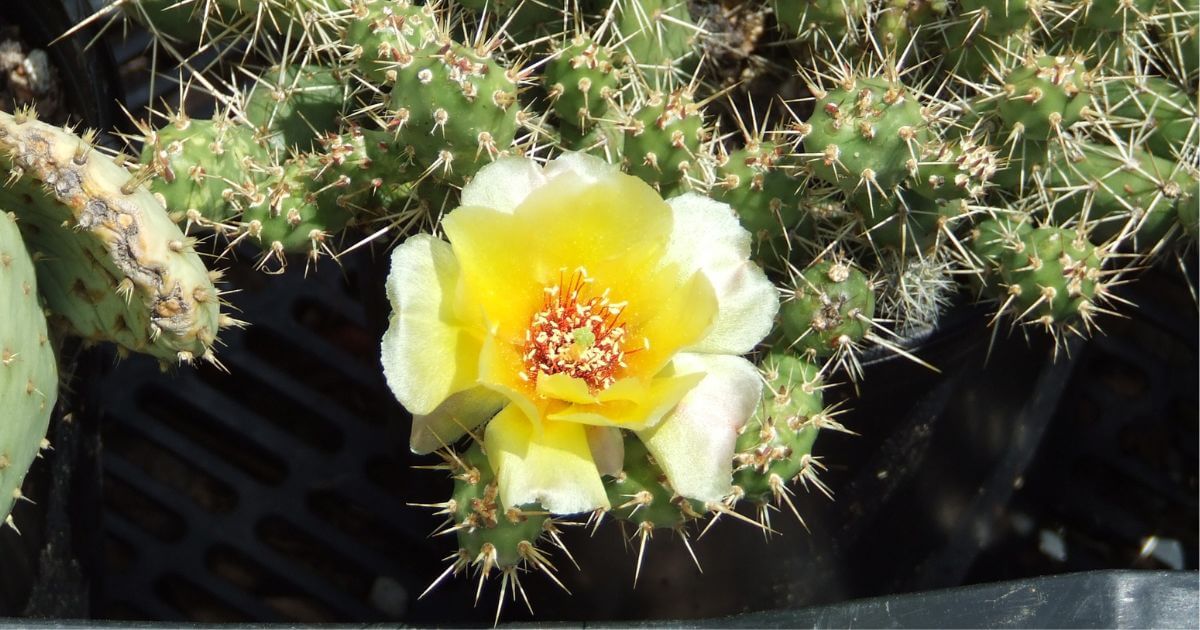
The gardens also have Opuntia fragilis, brittle prickly pear. The pads easily detach, hence the “brittle” description in the common name. This species is more widespread throughout Montana than O. polyacantha and often can be found in rocky outcroppings in and around Missoula.
Propagation for Prickly Pear Cacti
These cacti produce seeds, so you could always wait for the plant to produce blossoms and go to seed, then collect seeds and plant them. And then wait some more. Happily, there’s an easier, faster method, used by Sasha Victor in her work with Native Plant Propagation and Restoration, Conservation Lands Management for the City of Missoula:
- Slice or break off a pad from an existing prickly pear cactus.
- “Store the cut pad in a shady, dry location for a few days. This allows a callus to form over the cut … [this] helps prevent the pad from rotting and is a barrier to pathogens. The callus also helps promote successful rooting by triggering … hormones that promote root growth,” Victor says. The callus should feel dry and slightly hard before moving on to the next step.
- Lay the pad on a tray of potting soil mixed with perlite.
- Water every few days. Don’t overwater.
- Once the pad produces roots, plant it in your landscape or pot of cactus-specific potting mix. Both settings require good drainage.
If your prickly pear cactus:
… pads darken, wrinkle and flop, this is normal, end-of-season change as water is redirected from pads to roots. Wrinkling during the growing season may indicate dehydration. If the top half inch of soil feels dry, water until it’s moist.
… base becomes brown/hard from the bottom up, this is called “corking” and is a normal part of aging that spreads from the base upward.
… becomes brown from the top down, you might have spider mites or mealybugs. Three solutions: Blast pests off with water, being careful not to overwater the plant. Remove pests with a tweezer. Treat as recommended by your garden supply store.

Janet Cass is a Montana-based editor, writer and gardener.
Feature photo: Opuntia fragilis, ‘Compact form’ courtesy of coldhardycactus.com.
You may be interested in:
What’s Blooming? Prickly Pear
During several garden tours recently, I’ve spotted one of the few Minnesota-hardy cacti–Opuntia macrorhiza, which is commonly called plains prickly pear. It’s a native Minnesota…
Hardy Roses for Northern Gardeners
Nestled in the northwest corner of Oak Tree Park in Dilworth, Minn., lies a bed of roses that visitors have enjoyed since 2010. The roses…
Thanksgiving and Christmas Cactus
Schlumbergera is a houseplant that cheers up many a holiday home. Common names for members of this genus of cactus include Christmas cactus, Thanksgiving cactus,…