


All in the Family: Grex Seeds Boost Resilience and Flavor
Seed saving for specific variations, like disease resistance or color, has been part of the human-plant connection for thousands of years. For decades, the goal has been creating uniform seeds, those that produce exactly what gardeners expect. But those seeds may not produce the most resilient plants in the face of more intense weather.
That’s where grex seed comes in.
The term grex comes from Latin and means flock. It was first used in horticulture to describe varieties of orchids. “The idea of a grex of seeds can be explained like families,” says Dusty Hinz, of the Experimental Farm Network (EFN), a Pennsylvania-based nonprofit that is developing a collection of grex seeds suitable for home gardeners. “While hybrids are like twins, grexes are like when the whole family gets together to celebrate,” Hinz says. If you’ve ever planted Glass Gem corn, you’ve planted grex seed. Glass Gem seeds come in a variety of colors, but the seed color does not determine the color of the kernels on each cob of corn you grow.

Hinz, who is from Minnesota, and his co-founder, Nathan Kleinman, were both urban farmers and seed savers. They have a knack for finding unique yet forgotten seeds and nurturing them back
to multifaceted lives. They comb the USDA Germplasm Research Information Network to find promising seed stock. Breeding these forgotten seeds with rare seeds found on their world travels makes for endless opportunities to create stronger seeds, they say.
The pair work with established plant breeders and 40 growers across the country to test and develop new seeds. They’ve amassed a collection of grex seeds suitable for home gardeners, as well as “breeders’ mixes” for those wanting to create their own grex seed.
HOW A GREX HAPPENS
The first year of a grex grow-out for creating a perennial crop for cold climates is naturally culled by weather. Perhaps 20 percent of plants will thrive after the first Year, but up to 80 percent after the third. Seeds produce similar but not identical crops. “The third year is when the magic really happens with explosions of colors, shapes, textures and flavors,” says Nathan Kleinman.
Growers work to stabilize the variations to predictable options. Home gardeners may not see all The variations, but the diversity is in the plants.
Grexes in the Home Garden
My first experiment growing these seeds was in 2022 with EFN’s ‘Homesteaders Kaleidoscopic’ perennial kale grex. The dozen seeds I planted produced a dramatic diversity in leaf colors from
deep purples to greens, and shapes with some ruffled and some flat. The seeds themselves looked slightly different, but anyone could tell this kale was in the same family and distinct from other
standard varieties such as Darkibor and Scarlett.
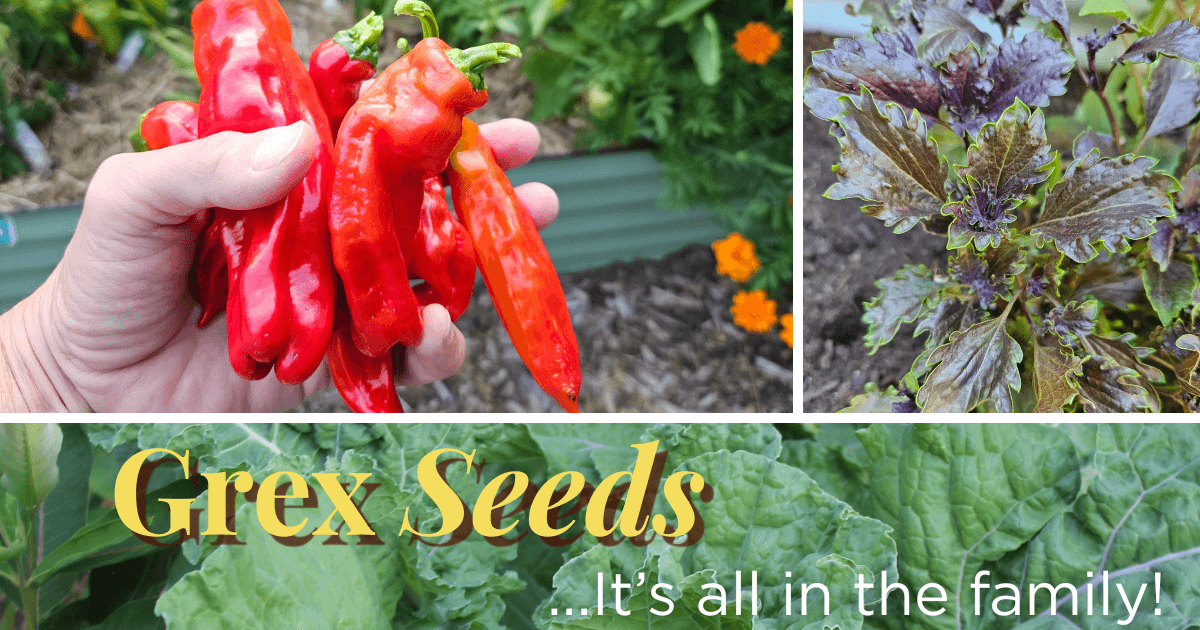
The plants also came back the next spring and produced beautifully with minimal mulching. A true, delicious perennial kale in a USDA Zone 4 garden is a huge step forward! I also grew EFN’s Mrihani x Opal F4 basil this year. I was impressed by the variations in color, form, fragrance, flavor
plus downy mildew resistance from a single seed packet.
Growing grexes has evoked a new love of plants and reminded me that every seed has a story, or maybe even several stories.
Seed Types
Seeds come in several types. Here’s what each name means:
- Open Pollinated – Any plant that is pollinated naturally by the wind or pollinators. Seeds will produce true-to-type (stable) harvests the following year.
- Heirloom – Seeds that are open pollinated and have been grown and stable for at least 50 years.
- Hybrid – Two different plants’ pollen is crossed to produce exact replicas. Seeds saved and replanted from a hybrid will likely produce characteristics of one or both parents, but probably won’t match your previous harvest. Denoted with an “F1” on seed packets.
- Cultivar – A standardized variety bred for particular traits including uniformity, such as ‘Green Zebra’ tomato.
- Grex – Seeds that have been crossed multiple times with similar plants. They show genetic variations within a predictable range. Increased resiliency from a small sample of seeds.
- Landrace – Adapted to a region, from non-standardized, genetically diverse, open pollinated seeds. These are grown to bring out possible genetic variations.
Note: A plant can be all of the following: landrace, grex and open-pollinated. Heirlooms produce true to type so they can be a landrace and open pollinated but not a grex.
This article originally appeared in the winter 2023 edition of Northern Gardener® Magazine.
Michelle Bruhn is a Minnesota gardener, writer, speaker, local food advocate and co-author of Small-Scale Homesteading (Skyhorse Press, 2023).
You may be interested in:
Seed Catalogs 101
The snow squeaks under your boots as you trudge through the drifts to the mailbox. It’s only December, but you’re already growing weary of the…
Seed Garden Design
Want a stunning display of vibrant flowers next year? This spring, try sowing a variety of annual flower seeds directly in the ground shortly after winter’s last frost. By midsummer, these easy-to-grow annuals will transform your garden into a lively and colorful showcase of blooms that will last until early autumn. Follow this simple plan for a flourishing summer garden that requires minimal effort for maximum wow.
Starting Seeds Indoors
Are you excited for gardening season and can’t wait to get your hands dirty? Start seeds indoors with step-by-step instructions from the University of Minnesota Extension.