


Iceberg Alley Sageleaf Willow
Many recent shrub introductions have offered northern gardeners colorful foliage to accent their gardens. Whether it is the reds or purples of ninebark, the chartreuse of spirea or sumac, or a great variegated dogwood, foliage can brighten up our gardens all season long.
Until recently, we’ve not had shrubs with silver foliage. We have some great silver-leaved perennials, such as Artemisia (‘Silver Mound’ and ‘Valerie Finnis’) and Stachys (lambs ears), but not a woody shrub.
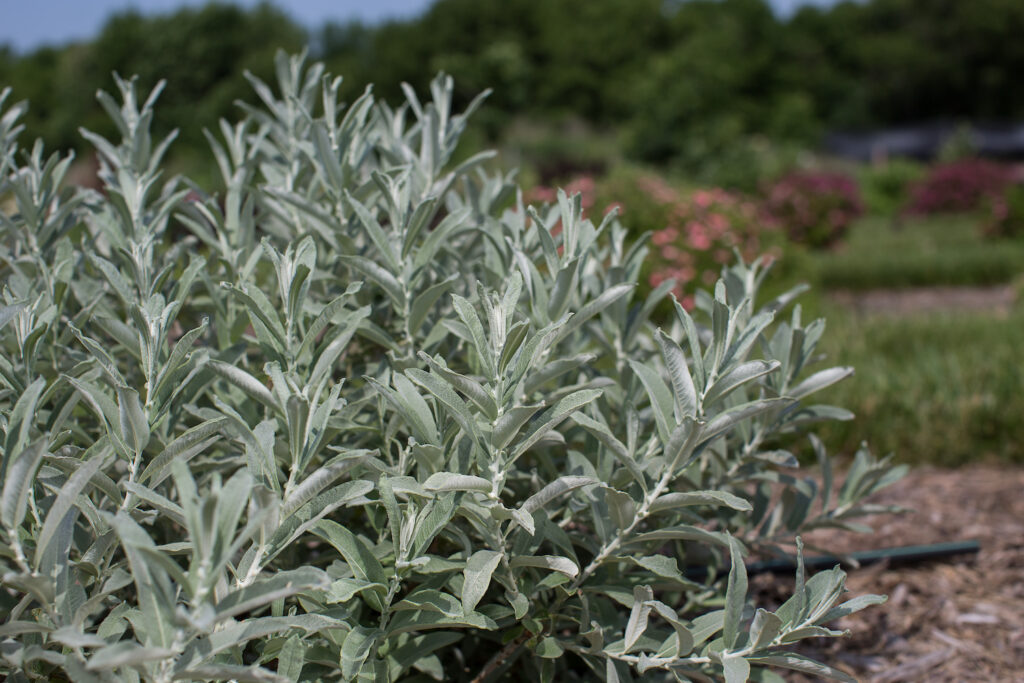
That has all changed with the recent introduction of a native sageleaf willow cultivar called Iceberg Alley™. This little gem of a shrub was discovered at the Memorial University of Newfoundland and Labrador Botanical Garden in Canada.
Hardy to USDA Zone 2, this shrub will work for all northern gardeners. The very textural foliage feels hairy and soft, and has a lovely silvery hue. As you can see in the photo, the leaf is longer than it is wide. The silver is apparent from the moment leaves emerge in spring through autumn, when they turn yellow (unfortunately not a spectacular yellow) and then eventually fall off.
Iceberg Ally sageleaf willow is relatively small, so it will fit in urban yards and foundation plantings. You could even use it as a dramatic backdrop to your perennial garden. At maturity, it’s 3 to 5 feet tall, with a spread that is slightly larger than the height. It requires little pruning, unless you want to control the height or spread. If that’s the case, prune away, as it tolerates pruning well.
In spring, it produces a pretty silver catkin with red stamens that can be cut for early spring decoration. Iceberg Alley is a male plant, which produces pollen and nectar. Researchers in Canada observed it to be a favorite of honeybees, bumblebees, syrphid flies and some butterflies.
As with most Salix, it tolerates moist soils but does not require them. It is best grown in a site that gets about six hours of direct sunlight daily. It has no major disease or pest issues. This shrub is very easy to grow. It is propagated via softwood cuttings and is protected by a plant trademark.
Pair it in the foundation planting with Hydrangea paniculate, which blooms in mid- to late summer, or with other shrubs with foliage colors that will contrast with the silver. It looks especially striking next to shrubs with red to purple foliage, such as the many ninebarks on the market.
Introduced in 2019, Iceberg Alley should be available in local garden centers this summer and fall.
This article by Debbie Lonnee originally appeared in the July/August 2020 issue of Northern Gardener. She works in the horticultural industry and gardens in South St. Paul.


What kind of soil will this plant need?
Baileys Iceberg Alley sageleaf Pussywillow
My plant is losing its leaves…any idea what could be happening? Just planted it this spring. We have too many rabbits this year, so I circled it with chicken wire to protect it. Normal watering schedule. Any known issues with this plant?
Mine is losing its leaves too. I keep it moist like I read to do. I’m thinking it is getting too much sun. I have it in a south facing yard and it’s been pretty hot for an extended time this summer. I put it in about a month ago, so I’m really hoping it is having a little shock after coming from the nursery. I really like where it is at so I don’t want to move it if I don’t have to. But sometimes we don’t get to decide where it’s happy! I’m going to wait and see what happens. If it gets real bad I’ll move it to where it will get some shade.
Does this type of willow have invasive roots that where it should be planted a certain distance away from foundations and septic systems? I planted one of these and two dwarf blue arctic willow nana right up near the house and I’m going to move the nana after reading some comments about the roots getting very thick and reaching far. Wondered if all willows, even these shrub varieties, should be planted about 50 feet away from anything they could damage like you should the trees. Thanks so much!
Same with the leaf loss. I suspect too much sun as well. After reading the other comments. I think I am going to move it, I really, really like it, and hope it thrives.
My plant was just planted in July. It is in the required amount of sun, not too much, and is pretty consistently moist with irrigation and a nearby, hose-fed birdbath. It’s now almost the end of August, and it is looking a little mangy, with some leaf drop and general lack of vigor, after an initial, satisfying, burst of activity! I’m going to see what happens in spring, but I suspect, that as with other light leafed plants such as Ivory Halo dogwoods, the first season is best ignored. Once established, I am guessing this thing will be very happy in all the sun everyone is mentioning. It’s a willow! It wants some sun. Some plants are just very susceptible to transplant shock. Let’s hope, bc I love it, and am already including it in client plans.