


Planting a ‘Rug Garden’ for Big Harvests in Small Spaces
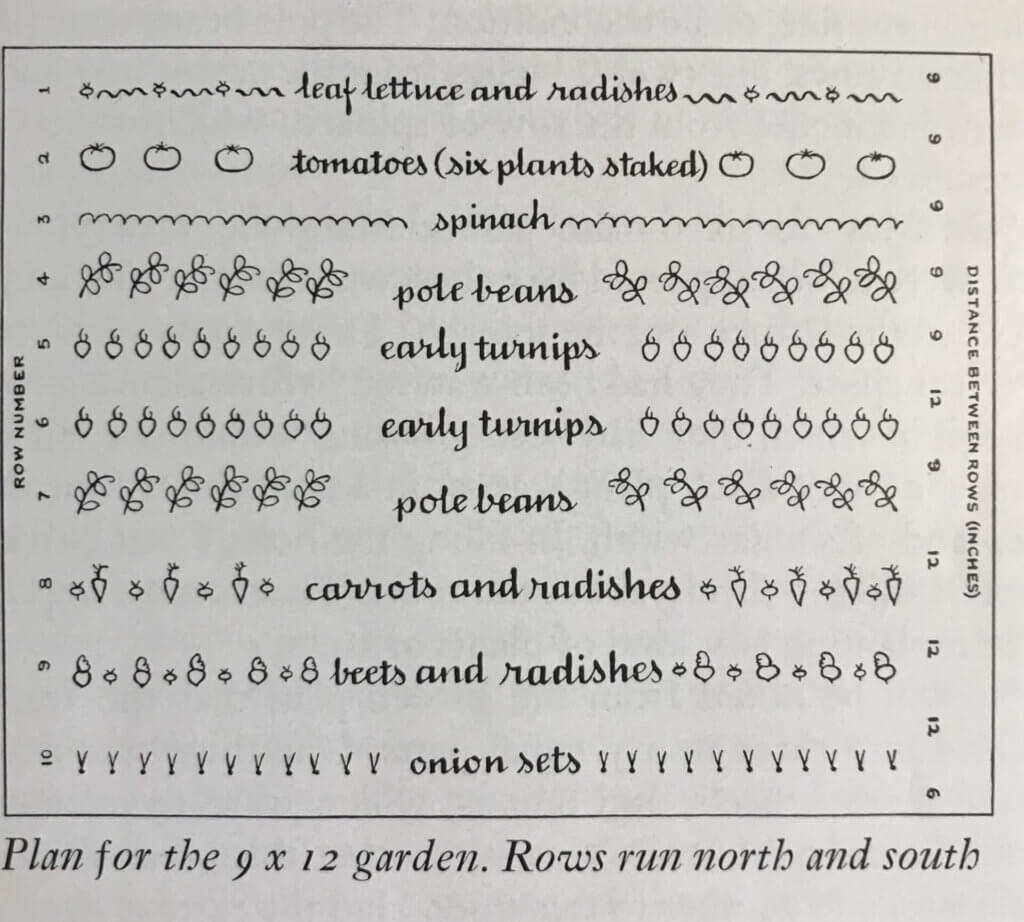
A few years ago, while researching my book The Northern Gardener: From Apples to Zinnias, I came across a wonderful pamphlet from the University of Minnesota called Let’s All Grow Vegetables by Grace Keen and Arthur Hutchins. Published in 1944, the book includes a discussion of what it would take to grow food for two from a 9-by-12 foot plot—what they called a “rug garden.”
“There is no such thing as a space too small for a garden,” Hutchins wrote. The rug garden idea came from another University of Minnesota professor, William H. Alderman (yes, the Alderman Hall guy). Alderman planted the garden as an experiment to demonstrate how much food can come from even a small space.
Measuring your space
He started in mid-April, measuring out the space and planting his first cool-season crops in north-south rows. These included lettuce, spinach, radishes, carrots, beets, onion sets and turnips. The radishes, which germinate and grow quickly, were sprinkled amid lettuce, carrots and beets with the idea of pulling them as they matured to space plants properly. Generally, he planted things close together—at least by standards of 80 years ago.
Adding and rotating in new crops
By May, some weeds had sprouted and those had to be pulled. Later in the month, he planted his warm season crops, including Kentucky Wonder pole beans (a variety that is still available and very good) and six tomato starts that were staked to help them grow up rather than out. Alderman pruned these throughout the summer to keep their foliage growth in check.
Pest management in a small garden
Rabbits and cabbage maggots invaded the garden, but with some replanting and wire covers, he was able to protect much of his crop. Turnips turned out to be a failure, but Alderman carried on. He realized later he had also planted too much lettuce for his family of three to eat. Plant what your family likes is the advice he gave, and we wholeheartedly agree with it.
Does a rug garden really work?
Alderman harvested his first radish on May 23 and his last beets and carrots were put in storage Oct. 3. The garden produced the equivalent of 537 servings of vegetables, according to Alderman, most of which were eaten fresh. The family canned some tomatoes, froze a lot of beans and stored beets and carrots in their dry cellar. Onions also were dried and stored for several months. The six tomato plants produced 66 tomatoes and the pole beans more than 56 pounds of beans. They were able to store 40 onions for the winter. Not bad from such a small space!
Here’s what Alderman said, “It provided my family with a very significant portion of our year’s food supply, and it provided me with a lot of good fun and recreation to say nothing of a never failing conversation piece when guests were present. . . .I am confident that I can produce more for the yield of the individual crops was not exceptional.”

Mary Lahr Schier is a Minnesota gardener, writer and editor and author of The Northern Gardener, From Apples to Zinnias, 150 Years of Garden Wisdom (Minnesota Historical Society Press, 2017), winner of the Silver Award of Merit from GardenComm in 2018. For 18 years, she edited Northern Gardener magazine, the publication of the Minnesota Horticultural Society and the only magazine dedicated to gardening in USDA Zones 3, 4 and 5..
You may be interested in:
Small Space Vegetable Gardens
If your only growing space is on a deck or patio, don’t fret.Almost any veg can grow in a container. I began to grow vegetables…
4 Common Insect Pests in the Vegetable Garden
Before we even start talking about pests, let’s be clear: Most bugs are good bugs, and trying to keep your vegetable garden bug-free is not…
Gifts Ideas for Small-Space Gardeners
Apartment, condo and townhome residents and anyone else gardening in a small space, we salute you. A tiny or even non-existent yard won’t stop you—your…